15 May 2024

Observing Tips for the Moon

Our lovely Moon is a steadfast companion, a glowing orb that faithfully accompanies us in our journey around the Sun every year. The Moon presents us many facets in its 29-day journey around the Earth and is a wonderful object to look at with visual aid such as binoculars or a telescope. I recorded a podcast to share some insights about our Moon and some tips how you can really savor the view. The podcast is part of the Translunar series recorded for the Bavarian Public Observatory nearby where I live in Munich, Germany. 

"Observing Tips for the Moon" on the Translunar Podcast.

Image courtesy of NASA 

17 April 2024

Seeing the International Space Station (ISS)

Looking up into the night sky, we can see many satellites gently gliding across the heavens on any clear night. Some are faint, others brighter. But nothing rivals the International Space Station when it makes a pass overhead. The largest artificial satellite in orbit around the Earth, the ISS circles the globe every 90 minutes and is usually visible for 1-2 weeks at at time in any given location. I recorded this podcast to provide some guidance on the how, why and where of the ISS.

"Seeing the ISS" on the Translunar Podcast. 

Image courtesy NASA. 
01 April 2024

A Podcast on Astronomy: Translunar

Please try out a very fine astronomy podcast called Translunar (Apple, Spotify). It is a production of the Munich Public Observatory (Volkssternwarte München, where I am a member) and there are bi-weekly episodes in English and German now available. My latest podcast features a tour of the late winter / early spring night sky and you can join for the tour by simply putting on your earbuds and walking outside to take a tour with me. We tour the "Winter Hexagon," a very brilliant part of the late winter / early spring night sky. 

11 February 2024

Total Solar Eclipses and the Great American Eclipse on April 8, 2024


A total solar eclipse is one of the most amazing visual and sensory experiences you can find in nature, a combination of astronomical alignments and local phenomena that combine to dazzle us humans when we witness this spectacle. I caught the 'solar eclipse bug' decades ago and have traveled far and wide over the past years to be in the shadow of the moon many times. I find it to be a profoundly moving experience, and I am heading to the next one in April 2024 that will be visible across a large swath of North America. During a total solar eclipse, there are three broad categories of the experience. 

In no particular order: 

The Heavens Above:
an eclipse happens when the moon, sun and earth are perfectly aligned and the penumbral (dark) shadow of the moon traverses the earth's surface. During the partial phases, a little more than an hour long, the sky dims very gradually, but in the last 10 minutes before totality the change in the sky is dramatic, going from daytime blue to sunset blue. Planets are suddenly visible and a few bright stars as well. And then, when the moon fully covers the sun's disk, the image in the sky is stunning. For a few brief minutes you can view the eclipse without eye protection and see the outer atmosphere of the sun, the solar corona. If you have a telescope or binoculars, you can see the solar prominences, beautiful red flares that flow out from the solar surface. The images here were taken by amateur astronomers near my viewing site in Australia. 

The Earth Below: as the partial phases progress, the nature of the light changes as the light source, the sun, changes from a round ball to a crescent to an ever-diminishing point of light. The shadows on the ground develop sharp edges and the light of the sun filtering through trees takes on a crescent shape. The air cools noticeably, and the wildlife starts to react. I have been in many an eclipse where flocks of birds set flight just before or after totality. The rapid cooling of the air often leads to a light breeze. And the horizon become brighter than the sky above you as the shadow of the moon envelops you and everything around you. 

The Humans Around You: I enjoy going to eclipses where there are other people around me. Sometimes I lead a group, or other times I take part in a tour. Either way, I find it remarkable how the eclipse affects us as human beings, whether someone has seen many eclipses or is witnessing this for the first time. The buildup is so gradual and slow that you could barely notice unless you have a telescope with a solar filter (which I always have with me). But as the final minutes tick down to totality, there is a noticeable buzz in the people around you and at the last moment as the diamond ring effect takes place, there is an outcry from those around you ... a kind of group exhale combined with a primal scream ... because this incredible visual image appears magically in the sky. I enjoy the energy of this shared experience. 

There are so many aspects of eclipses to learn about, I cannot cover all of this in one blog post. So here are some helpful links for the curious reader.  

Third party posts: 

NASA Eclipse Website with focus on April 2024.

Great American Eclipse website with lots of resources and maps for April 2024. 

My own posts: 

Solar Eclipses and the Saros Cycle - a previous blog post focused on the celestial dynamics that underlie eclipses. 

2006 Eclipse in Turkey - a short blog post about my experience in Turkey in 2006.

2023 Eclipse in Australia - a short blog post about my experience in Australia in 2023.

Images courtesy of Aditya Madhavan. 


18 October 2023

Lunar X and V on October 21st


The Moon is a fantastic target for anyone with a telescope or binoculars. There is so much richness to see and on any night the Moon presents an ever-changing landscape, each night different from the previous one. I particularly like first and last quarter moons, as you get a side view of the terminator and can observe the long shadows in the craters. But those shadows and the rapidly changing lighting effects on and near the terminator create striking patterns for those with a good telescope. 

Lunar X and V
The Lunar X and V are two striking patterns that appear monthly on the surface of the first quarter Moon. Visible through a telescope at moderate magnification, these two patterns are visible for a few hours, one after the next, but of course you need to have the good luck of the Moon being above the horizon at that exact time each month. So it is a somewhat rare occurrence and a fun target for amateur astronomers, or just about anyone who wants to put in the time to find it. Enlarge the image to the right for a close-up look. 

This month the view is favourable where I live, here in Munich, Germany. On Saturday October 21st the X and V features will be visible just at sunset and for an hour or two afterwards. I will host a star party in the Englischer Garten in Munich for the public and I hope that many will join to see this unique spectacle.  

19 April 2023

Total Solar Eclipse in Australia: watch live

As an Eclipse Chaser, I often travel long and far to see a total solar eclipse. Today is no exception, as I find myself in Western Australia to witness the Ningaloo Solar Eclipse from Exmouth. There are several live streams: 

NASA

Australian Geographic 

Happy viewing. I'll post comments later. 

- - - - - - - - - - - - - - - - 

Here is my report from later on 20 April: it was an impressive eclipse, with a very sharply defined corona. The prominences were like I have never seen before, with one very extended prominence and one beautifully curved prominence that had a broken filament. The sky was crystal clear and the spectators at my site here in Exmouth were quite excited by the whole thing. 

I have added two photos from the photographers next to me. The one above shows the Diamond Ring effect, and the one below totality with the solar corona. 


14 May 2022

Total Lunar Eclipse: 15-16 May 2022

A total lunar eclipse takes place on the evening of May 15th, continuing into the early morning of May 16th. It favors the Western Hemisphere, with best viewing conditions in the evening and late night of Sunday May 15th. For those on the West Coast of the US, the Moon will rise in deep partial eclipse and reach total phase at 8:29 pm pacific time, just after sunset in Los Angeles. Further east, the full eclipse will be visible in darkness. In eastern time zone, the partial eclipse starts at 10:28 pm and reaches totality at 11:29 pm. Totality lasts 1 hour and 25 minutes. Unfortunately for those in Europe, the eclipse will start in the early morning hours (4:28 in Germany) and will reach totality just as the Sun is about to rise, so it will be interesting but not nearly as impressive as when seen in darkness. 

No special viewing locations are needed, just a clear view to the south (and for the west coast of the US, a clear view to the east), and good weather. There are many factors that can affect the appearance of the eclipsed moon at totality ... largely due to weather conditions on Earth. And the 85 minutes of totality also can change in appearance from the start to the middle to the final moments before direct sunlight returns to the lunar surface. 

Sky and Telescope has an excellent write up for this event, with great details about many aspects of lunar eclipses. 

I wish you clear skies and a fun time viewing this special moment. 

Image courtesy of Sky & Telescope
10 August 2021

Perseid Meteor Shower 2021

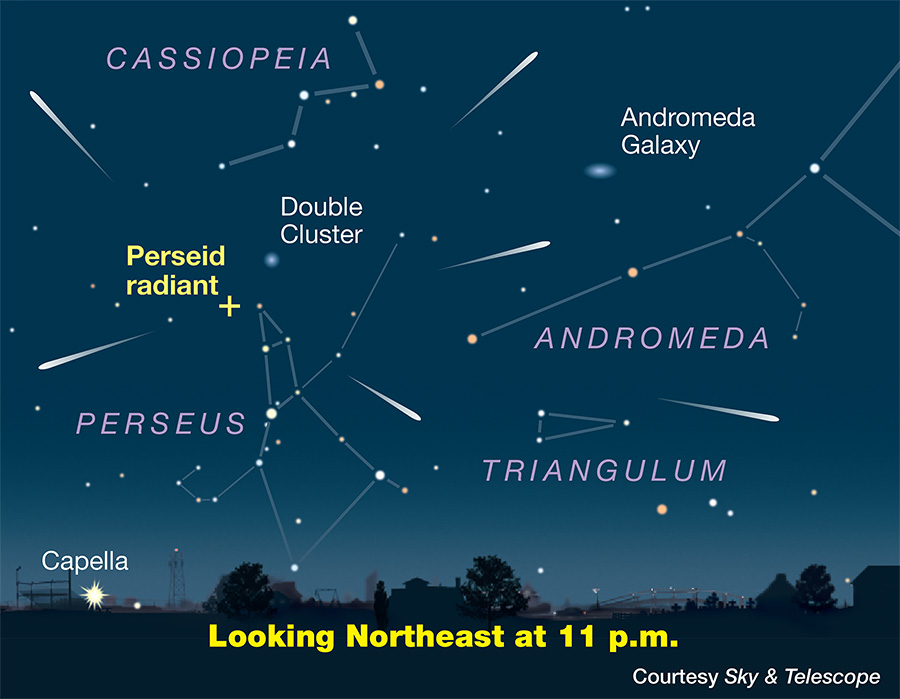
The Perseid radiant

The Perseids are upon us, literally. As the Earth sweeps around the Sun in its orbit, we gently glide through a region of space dust and debris, the remnants of a comet that passes through Earth's orbit every 133 years or so. And lucky for us, all of this debris is far too small to cause any damage to us on Earth, but big enough to light up the night sky every year. 

The Perseid Meteor shower in 2021 takes place over a two-day window on 11-12 August (through the morning of August 13th). The peak is expected to be late on the night of August 11th-12th. At the peak with very clear skies and dark conditions, you could see up to a meteor per minute. But that is an average, and sometimes you can have many minutes go by without any meteors, and then suddenly 2 or 3 all at once. So the best way to see the Perseids is to be patient, find a location with a broad horizon, and my favorite thing -- to do this in a group (even a group of two will do) since more eyes will see more meteors. I enjoy setting up the group to be looking in all different directions so we don't miss any meteors and even though no one person will see 100% of the meteors, we can all enjoy the excitement and fun with friends. Having a comfortable lounge chair and a blanket are a bonus and will enhance your viewing. 

As with every meteor shower, the viewing gets better after midnight when more meteors are flying into the atmosphere, so get lots of rest the night before and be ready for a long, relaxing night viewing one of the best meteor showers of the year. 

Lucky for us, we have a dark night for viewing the meteors, as the Moon is just a few days past New Moon phase and will set early in the evening. No light from the Moon makes the whole experience better. 

This article from Sky and Telescope is an excellent overview of the Perseids, not only tips how to best observe the shower, but why it happens every year and other interesting science. 

Image courtesy Sky and Telescope