Showing posts with label eclipse chaser. Show all posts

11 February 2024

Total Solar Eclipses and the Great American Eclipse on April 8, 2024


A total solar eclipse is one of the most amazing visual and sensory experiences you can find in nature, a combination of astronomical alignments and local phenomena that combine to dazzle us humans when we witness this spectacle. I caught the 'solar eclipse bug' decades ago and have traveled far and wide over the past years to be in the shadow of the moon many times. I find it to be a profoundly moving experience, and I am heading to the next one in April 2024 that will be visible across a large swath of North America. During a total solar eclipse, there are three broad categories of the experience. 

In no particular order: 

The Heavens Above:
an eclipse happens when the moon, sun and earth are perfectly aligned and the penumbral (dark) shadow of the moon traverses the earth's surface. During the partial phases, a little more than an hour long, the sky dims very gradually, but in the last 10 minutes before totality the change in the sky is dramatic, going from daytime blue to sunset blue. Planets are suddenly visible and a few bright stars as well. And then, when the moon fully covers the sun's disk, the image in the sky is stunning. For a few brief minutes you can view the eclipse without eye protection and see the outer atmosphere of the sun, the solar corona. If you have a telescope or binoculars, you can see the solar prominences, beautiful red flares that flow out from the solar surface. The images here were taken by amateur astronomers near my viewing site in Australia. 

The Earth Below: as the partial phases progress, the nature of the light changes as the light source, the sun, changes from a round ball to a crescent to an ever-diminishing point of light. The shadows on the ground develop sharp edges and the light of the sun filtering through trees takes on a crescent shape. The air cools noticeably, and the wildlife starts to react. I have been in many an eclipse where flocks of birds set flight just before or after totality. The rapid cooling of the air often leads to a light breeze. And the horizon become brighter than the sky above you as the shadow of the moon envelops you and everything around you. 

The Humans Around You: I enjoy going to eclipses where there are other people around me. Sometimes I lead a group, or other times I take part in a tour. Either way, I find it remarkable how the eclipse affects us as human beings, whether someone has seen many eclipses or is witnessing this for the first time. The buildup is so gradual and slow that you could barely notice unless you have a telescope with a solar filter (which I always have with me). But as the final minutes tick down to totality, there is a noticeable buzz in the people around you and at the last moment as the diamond ring effect takes place, there is an outcry from those around you ... a kind of group exhale combined with a primal scream ... because this incredible visual image appears magically in the sky. I enjoy the energy of this shared experience. 

There are so many aspects of eclipses to learn about, I cannot cover all of this in one blog post. So here are some helpful links for the curious reader.  

Third party posts: 

NASA Eclipse Website with focus on April 2024.

Great American Eclipse website with lots of resources and maps for April 2024. 

My own posts: 

Solar Eclipses and the Saros Cycle - a previous blog post focused on the celestial dynamics that underlie eclipses. 

2006 Eclipse in Turkey - a short blog post about my experience in Turkey in 2006.

2023 Eclipse in Australia - a short blog post about my experience in Australia in 2023.

Images courtesy of Aditya Madhavan. 


19 April 2023

Total Solar Eclipse in Australia: watch live

As an Eclipse Chaser, I often travel long and far to see a total solar eclipse. Today is no exception, as I find myself in Western Australia to witness the Ningaloo Solar Eclipse from Exmouth. There are several live streams: 

NASA

Australian Geographic 

Happy viewing. I'll post comments later. 

- - - - - - - - - - - - - - - - 

Here is my report from later on 20 April: it was an impressive eclipse, with a very sharply defined corona. The prominences were like I have never seen before, with one very extended prominence and one beautifully curved prominence that had a broken filament. The sky was crystal clear and the spectators at my site here in Exmouth were quite excited by the whole thing. 

I have added two photos from the photographers next to me. The one above shows the Diamond Ring effect, and the one below totality with the solar corona. 


27 March 2014

Preview of the Aug 21, 2017 Total Solar Eclipse

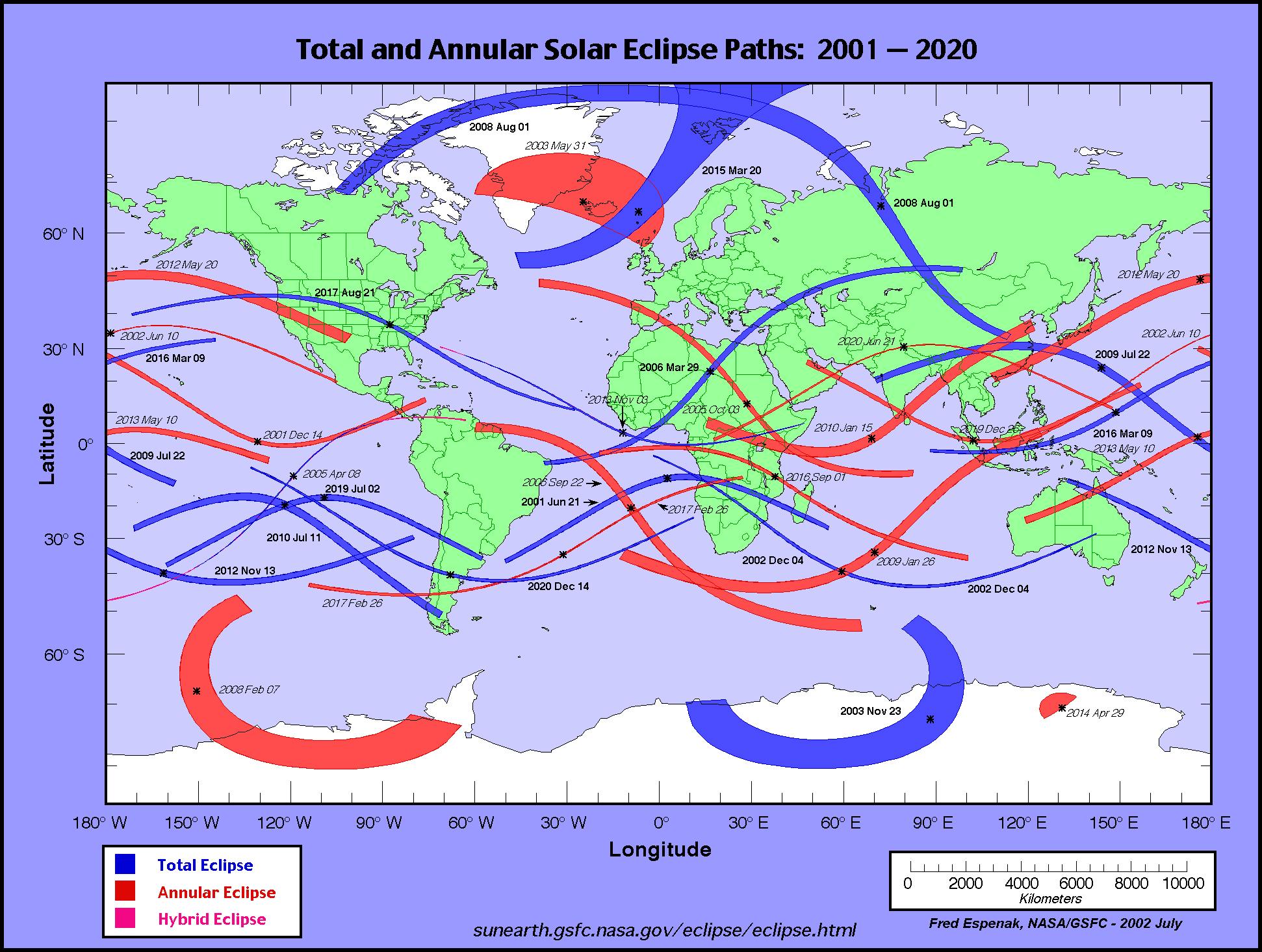
August 2017 Eclipse Path
I am a fan of total solar eclipses, and although it is a long time in the future, I want to provide some resources for those who want to learn about an incredible eclipse that will cross the entire North American continent in August of 2017. This summertime spectacle tracks from the Oregon coast to South Carolina and affords good views for up to 2 minutes and 40 seconds of breathtaking totality. The summer climate is mostly reliable along the eclipse track and the interstate freeway system ensures that local climate problems will be manageable should there be inclement weather in spots along the eclipse path. Here are some of the best online resources for planning to see the eclipse that I have found so far:

NASA's Eclipse Resource Center
Eclipse2017.org
Eclipse Chasers

Each of these sites offer tips and suggestions for getting to the right place and being ready for seeing an eclipse. Since weather plays such a critical role in the success or failure of an eclipse expedition, you'll need to carefully study Jay Anderson's excellent analysis. Jay is a legendary eclipse chaser and I was on his mission in 1991. I have come to respect his analysis as the best around.

31 August 2011

Big Astronomy Events in 2011 and 2012

Much of the time, I enjoy astronomy as a day-to-day hobby, taking in the sky often and enjoying the slowly changing view of the heavens. Sometimes, however, big events come along and obligate the observer to be present at a specific moment in time -- and also have the good luck of clear skies. We have a three such events in the coming year, and the San Francisco Bay Area is a good base from which to see these events.


This Lunar Eclipse will peak on Saturday morning, December 10th, just before sunrise here in San Francisco, meaning that if the skies are clear, the best view will be at the coast, where the Full Moon will be entering Total Eclipse just as it is setting over the Pacific. This will be impressive!


An Annular Eclipse, also called a "Ring of Fire" eclipse, happens when the Moon's disk fits "inside" the disk of the Sun, creating a ring of sunlight in the sky. It's not the same as a Total Solar Eclipse, but still a beautiful natural phenomena, one worth a trip to Northern California to see. The viewing path can be seen on the map in this link, and will pass near Redding and Mt. Shasta in Northern California. I'll be organizing a road trip with the San Francisco Amateur Astronomers (SFAA) to see this spectacle.


A transit of a planet in front of the Sun is a rare and unusual event. This is one of a pair of transits of Venus, the first of which occurred in 2004, paired with this one in 2012. Then we have a 100-year gap until the next pair of transits of Venus. It will be a daytime event, of course, because we are going to see the tiny disk of Venus cross directly over the Sun's disk.

- - - - - - - - - - - -

I'll write about each of these events as the time draws nearer, so for now the main thing is to mark your calendar and do a bit of background reading by following the links in this blog post.

Image courtesy of NASA.

22 July 2009

Total Solar Eclipse in Asia

Today a large part of the eastern hemisphere experienced a solar eclipse, and along a narrow band of Earth viewers were well positioned to experience a Total Solar Eclipse, a rare and beautiful phenomenon. Unfortunately for most, the summer weather was miserable and the skies were cloudy - something that eclipse viewers (and eclipse chasers like me) don't want. Still, there was some limited visibility from a few observing sites. The tour group organized by Sky & Telescope Magazine saw a "murky" total solar eclipse. Better than none, I suppose.

For those of you wishing to see one closer to home, you'll have to wait until 2017 for a Total Solar Eclipse in the USA.