Showing posts with label Meteor. Show all posts

10 August 2021

Perseid Meteor Shower 2021

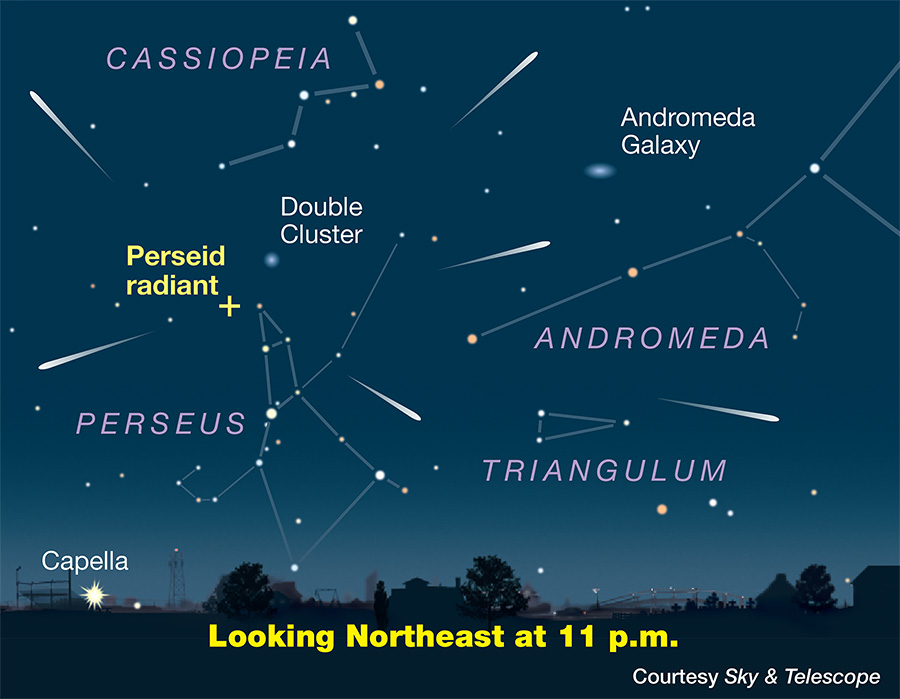
The Perseid radiant

The Perseids are upon us, literally. As the Earth sweeps around the Sun in its orbit, we gently glide through a region of space dust and debris, the remnants of a comet that passes through Earth's orbit every 133 years or so. And lucky for us, all of this debris is far too small to cause any damage to us on Earth, but big enough to light up the night sky every year. 

The Perseid Meteor shower in 2021 takes place over a two-day window on 11-12 August (through the morning of August 13th). The peak is expected to be late on the night of August 11th-12th. At the peak with very clear skies and dark conditions, you could see up to a meteor per minute. But that is an average, and sometimes you can have many minutes go by without any meteors, and then suddenly 2 or 3 all at once. So the best way to see the Perseids is to be patient, find a location with a broad horizon, and my favorite thing -- to do this in a group (even a group of two will do) since more eyes will see more meteors. I enjoy setting up the group to be looking in all different directions so we don't miss any meteors and even though no one person will see 100% of the meteors, we can all enjoy the excitement and fun with friends. Having a comfortable lounge chair and a blanket are a bonus and will enhance your viewing. 

As with every meteor shower, the viewing gets better after midnight when more meteors are flying into the atmosphere, so get lots of rest the night before and be ready for a long, relaxing night viewing one of the best meteor showers of the year. 

Lucky for us, we have a dark night for viewing the meteors, as the Moon is just a few days past New Moon phase and will set early in the evening. No light from the Moon makes the whole experience better. 

This article from Sky and Telescope is an excellent overview of the Perseids, not only tips how to best observe the shower, but why it happens every year and other interesting science. 

Image courtesy Sky and Telescope


14 November 2019

Meteors, Meteors, Meteors!

November brings the annual Leonid meteor shower which peaks on Sunday November 17th. This year we have a second potential show, a "Meteor Outburst" on the evening of November 21-22. Unforunately the Moon will interfere quite a bit with the Leonids, but will have considerably less impact a few days later for the meteor outburst. Let's look at these two events in more detail.

Leonid Meteor Outburst in 1833
Meteor showers are some of the most exciting spectacles to watch in all of astronomy. However, the best views require dark, clear eastern skies and a willingness to be awake when most people are sleeping. And this time of year, they require warm clothes! If skies are clear, the Leonid Meteor Shower should be visible this weekend during the night of of November 17-18, but because of the 3/4 lit Moon, the sky will be glowing and only the brightest meteors will be visible.

Meteors are tiny bits of rock and dust that enter the earth's atmosphere and burn up. These bits of rock and dust are floating in long orbits in space and the earth "runs into" these clouds of rock and dust. Because the earth is moving so fast, the rocks and dust that are struck by the earth heat up from the friction of earth's atmosphere. The result of this are brilliant streams of light that are often called "shooting stars" but aren't stars at all, just very small visitors that shine briefly and flicker out.

The meteor shower coming up this weekend is called the Leonids and it is the result of the meteor stream from a comet known as Temple-Tuttle (comets are usually named after their discoverers). The shower is called Leonids because the comets appear to originate in the part of the sky where we find the constellation Leo the Lion. This constellation does not rise in the east until very late in the night and as such, we don't get the best view of the Leonids meteors until after midnight. This article by Deborah Byrd on EarthSky is very informative about the Leonids this year.

The "Meteor Outburst" a few days later is due to a similar cause as the Leonids themselves, the debris stream from a yet-to-be-discovered comet that has left a trail through which Earth will pass. That will happen on the night of November 21-22. This article from Sky & Telescope Magazine does an excellent job outlining the circumstances of the outburst and indicates that in the US you can expect a peak on the 21st around 8:50 pm pacific, 11:50 pm eastern, and here in Munich Germany around 5:50 am on the morning 22nd. I'll be up early to see if in fact we will get 100s of meteors storming in all at once. Can't wait!

Image credit: Public Domain / Wikimedia Commons

22 February 2013

KGO Broadcast - February 16, 2013

Last Saturday I had a fun experience: joining KGO 810 Talk Radio in San Francisco for a one-hour broadcast. Greg Gory invited me to stop by and talk about asteroids, meteors, fireballs and many other astronomy topics, and we had a fine time doing all of that and more! We entertained calls from listeners and ended the show on a high note, discussing why we go into space and explore in the first place. Click here to listen.

30 December 2011

Quadrantid Meteor Shower 2012 - peaks January 3-4

The annual Quadrantid Meteor Shower peaks on January 3rd and 4th, with the possibility to deliver a great show for viewers across North America. The Moon will interfere in the early stages of viewing, but despite that, the shower should be a good one.

Meteor showers typically are strongest after midnight, when the Earth's 'front face' is moving directly into the meteor stream as the Earth moves in its orbit around the Sun. In addition, many meteor showers have a peak where the meteor stream is strongest. This year, North America is well positioned for the Quadrantid peak. For those of us on the west coast of the US, the peak should start around 11:00 pm on Tuesday January 3rd, and continue into the morning hours of Wednesday the 4th. You can read more about the meteor shower peak in an excellent article from the American Meteor Society. The Quadrantid 'radiant' is near the handle of the Big Dipper, which will be high in the sky in the morning hours.

Viewing the shower is easy. From 11:00 pm until 2:00 am (west coast time), face east as the radiant rises and climbs into the night sky. Later in the night, after 2:00 am, the Moon will be low and then set, and the best view will be directly overhead, ideally lying on your back in a dark location with a sleeping bag and warm clothing - it will be cold! In San Francisco, I find that I can see many meteor showers from my own backyard, despite being in a big city. The two important things to do are (a) find a location where streetlights and houselights are not shining in your eyes, and (b) allow for 10-15 minutes to fully dark-adapt to the night sky, and then you can expect to see meteors. If you just look outside for 1 or 2 minutes and don't see any, you should not be surprised. Meteor viewing requires patience and a little bit of planning. But the investment of time is worth it, because meteors are such beautiful cosmic things. I wish you clear skies and good viewing!

Image courtesy EarthSky.

20 October 2011

Orionid Meteor Shower 2011

The Orionid Meteor Shower peaks for the next two mornings, October 21 and 22, as the Earth passes through a debris stream left by Halley's Comet. Like all annual meteor showers, the Orionids occur at the same time each year because the Earth, in its 365-day trip around the Sun, passes through areas of increased debris, leading to a much more focused period of time with meteors flying into Earth's atmosphere and creating those beautiful streaks of light that magically light the sky for a moment and then vanish without a trace.

The name Orionids tells us that the meteors in this shower appear to emanate from the constellation Orion, the beautiful winter sky constellation. But like the best meteors in any shower, you won't see Orion until after midnight as it rises out of the east. Meteor showers are best observed between midnight and sunrise, when you are viewing meteors entering our atmosphere on the 'front face' of the Earth. Given that sunrise is quite late this time of year, take advantage of that and get up just ahead of dawn's light, around 6:15 in the San Francisco Bay Area.

Image courtesy of Earth Sky.

04 May 2011

Eta Aquarid Meteor Shower 2011

Meteors are wonderful to see, arriving unannounced and fleeting in an instant across the sky, obligating the hopeful viewer to pay attention or miss this spectacle of the heavens. On any given night if you simply are out viewing the skies, you will probably see one or two, but throughout the year there are special times when the Earth's orbit takes us through a region of space dust, creating meteor showers, in which the intensity and regularity of meteors increases dramatically.

The Eta Aquarid meteor shower peaks Thursday night, the night of May 5th into the morning of May 6th. This is not the biggest meteor shower of the year, but it certainly is interesting because it is caused by small bits of debris from the trail of Halley's Comet, the famous comet that orbits the Sun and is visible from Earth every 76 years. Comets leave small trails of debris in their wake, and comets that have orbits that intersect the orbit of Earth around the Sun create our annual meteor showers. So if you see an Eta Aquarid meteor tonight, you'll know it was once part of Halley's Comet, having been stripped away by the heating of the Sun on some past fly-by of Earth.

To see this shower, as is the case for all meteor showers, you need a dark location (even a backyard shielded from streetlights in the city will do), warm blankets, a recliner chair or a patch of grass to lie on, a big view of the sky, and patience. The name of this shower is based on Aquarius (the constellation) where the meteors appear to originate from, but they are visible all over the sky. Best viewing for this shower is early morning. The dawn sky will start to brighten around 5:00 am, so you will need to start early Friday morning if you want to see these. Have fun!

30 December 2010

Quadrantids Meteor Shower - January 3-4, 2011

2011 starts with an impressive meteor shower for those ready to brave a cold night. The Quadrantids take place the night of Monday January 3rd into the morning of Tuesday January 4th, and are made better by the fact that the Moon is new, meaning no interference from moonlight.

As always, the best viewing of any meteor shower is from a dark location, ideally away from city lights. But I have had some success right in my backyard in San Francisco by positioning myself away from direct lights such as streetlights and houselights, and allowing myself 5 to 10 minutes to adapt to the darkness. Once dark adapted, the winter sky shimmers and Quadrantids are readily visible. In dark skies outside of cities you can expect up to 2 meteors per minute, but in the City I am happy to see 1 meteor every few minutes. This year should be as good a show as any, and despite our rainy Northern California weather the outlook is good.

To see this shower, position yourself facing northeast but give yourself as much of a view of the sky as possible. A lawn chair is best (along with blankets and a hat), as the meteors appear to originate in the constellation Bootes in the northeast part of the sky, but the meteors radiate in every direction away from this point.

For some fun background and history of this meteor shower, check out Astronomy.com and NASA's "What's Up" blog series. Image is courtesy of NASA.

Stay warm, and here's to good skies!

11 August 2010

Perseid Meteor Shower 2010

The Perseid Meteor Shower reaches its peak this week and the timing is very good for a fine display of meteors. Every year when the Perseids come around, the biggest concern is the Moon. Its beautiful light is a welcome sight to many, but for amateur astronomers and anyone wishing to see more than a few meteors, moonlight can ruin an otherwise-perfect evening of viewing. This year the Moon is very young during the Perseids and sets not long after sunset, leaving a dark sky for the shower.

The Perseids peak on the nights of Thursday 12th and Friday 13th, with best viewing on Thursday night / Friday morning. You can get detailed information on the Sky and Telescope website or on numerous other web resources.

The best way to see the meteor shower is to find a dark location, give your eyes plenty of time to adapt to the darkness, and be prepared to stay up late (or get up early). Meteor showers are almost always best viewed after midnight when the Earth is powering directly into the meteor stream and the rate increases substantially. The Perseids appear to originate in the constellation Perseus which is in the east after midnight, but that does not mean you have to specifically look east to see the meteors. Lying on a blanket facing directly overhead gives you the most expansive view and you can see meteors coming from the east or passing overhead toward the west. Meteors are wonderful, fast, elusive wonders and you simply need to be warmly dressed, in a place where you can see as much of the sky as possible without light distractions, and patience. I wish you clear skies and a great night or two observing.

10 August 2009

Perseid Meteor Shower 2009

It's August and that means its time for the annual Perseid Meteor Shower, this year reaching its peak on the evening and through the morning of August 11-12. Meteors are visible just about any night of the year, but throughout the year there are periods of intense activity in the sky ("meteor showers") because the Earth travels through a point in its orbit where there is a higher amount of space dust, rocks and other particles that enter the atmosphere at tens of thousands of miles per hour and burn up, creating bright streaks across the sky.

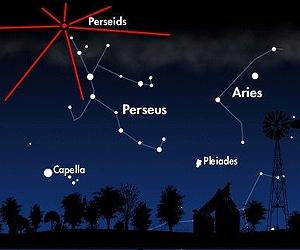
The Perseid Meteor Shower is going to be harder to see in 2009 because of the bright Moon that rises at 10:40 pm in San Francisco. For the city dweller, however, the shower is not much worse because of the bright Moon, as our city lights obscure many meteors anyhow. So the best you can do is simply enjoy the shower the evening of August 11th from wherever you are in the city. Pick a darkened comfortable spot. Lay back on a blanket and point your feet to toward the north-east and look around the sky. As the evening wears on, the origination point ("radiant") of the meteor shower rises in the north-east. This area is near the constellations Perseus and Cassiopeia as shown in the illustration to the right.

This year there will be a possible jump in the number of meteors as the Earth passes through a denser-than-usual filament of dust from the remnants of comet Swift-Tuttle. That will happen around 1:00 am pacific time on the 12th, so if you are up late you might just see a more intense period of meteor activity. Throughout the entire evening, the Moon will remain the one bright light everyone cannot escape, so when it rises just point your gaze in another direction and keep your eyes on the sky. And stay warm!

If you want to see a good meteor shower this year that won't have moonlight in the way, look ahead to December 14th when the Geminids will peak at an even higher rate than the Perseids. However it will be considerably cooler and the weather is less predictable at that time.

03 January 2009

Resolution for 2009: See more meteor showers

I awoke this morning shortly after 5:00 and dressed warmly to see the first meteor shower of 2009, the Quadrantids. I had just been reading about this shower the night before and it sounded like it would have an impressive peak at 5:00 pacific time. The conditions looked good from inside my house, so I ventured to my backyard and looked high into the north-east. It took only a minute or two before I was rewarded for my efforts: a pinpoint of light streaked across the sky for an instant. I was energized and focused and saw a particularly bright one a minute later. In my brief 15 minute session, I saw about 8 meteors. By then the first light of dawn was beginning to color the eastern sky and I was ready to hop back into bed!

Meteors are a delight from my point of view for a variety of reasons. They are high-speed astronomical events, those rare things you can encounter in the sky that are fast and require you to pay attention, like a total solar eclipse. Meteors are quick and yet they leave the impression of a long trail in your eye (sometimes the long streak is real, but often it is just a visual memory). My favorite thing is that they are silent. I always expect them to make a sound like an exploding firework, but despite the fact that we are witnessing mass vaporizing in an explosion of heat and brightness, nearly all meteors make no sound. The occasional fireball that is of massive proportion (such as a recent fireball over Canada) are the extremely rare spectacles that might create some local sound.

Meteor showers are annual events that are specifically tied to a time of year and a location in the sky from which the meteors all appear to radiate. For 2009, I am going to make a point of seeing more of these. Typically meteor showers peak after midnight and are best seen when there is no interference from the moon. So for the 10-12 major showers that occur in a year, the phase of the moon will make some of them easier to see than others. Of course, weather plays a role like it does for any other astronomical viewing - the clearer the atmosphere, the better the viewing. And of course the darker the sky, the more meteors you will see. Last night was a chance alignment of nearly all these factors: no clouds, clear atmosphere and no moon. So I jumped at the opportunity to enjoy the sight of the Quadrantid meteors. Even in the city lights of San Francisco the conditions were favorable enough to see some.

The informative astronomy website EarthSky has an excellent summary of the major meteor showers in 2009. Mark your calendar and plan to see a few - they are truly beautiful to witness.