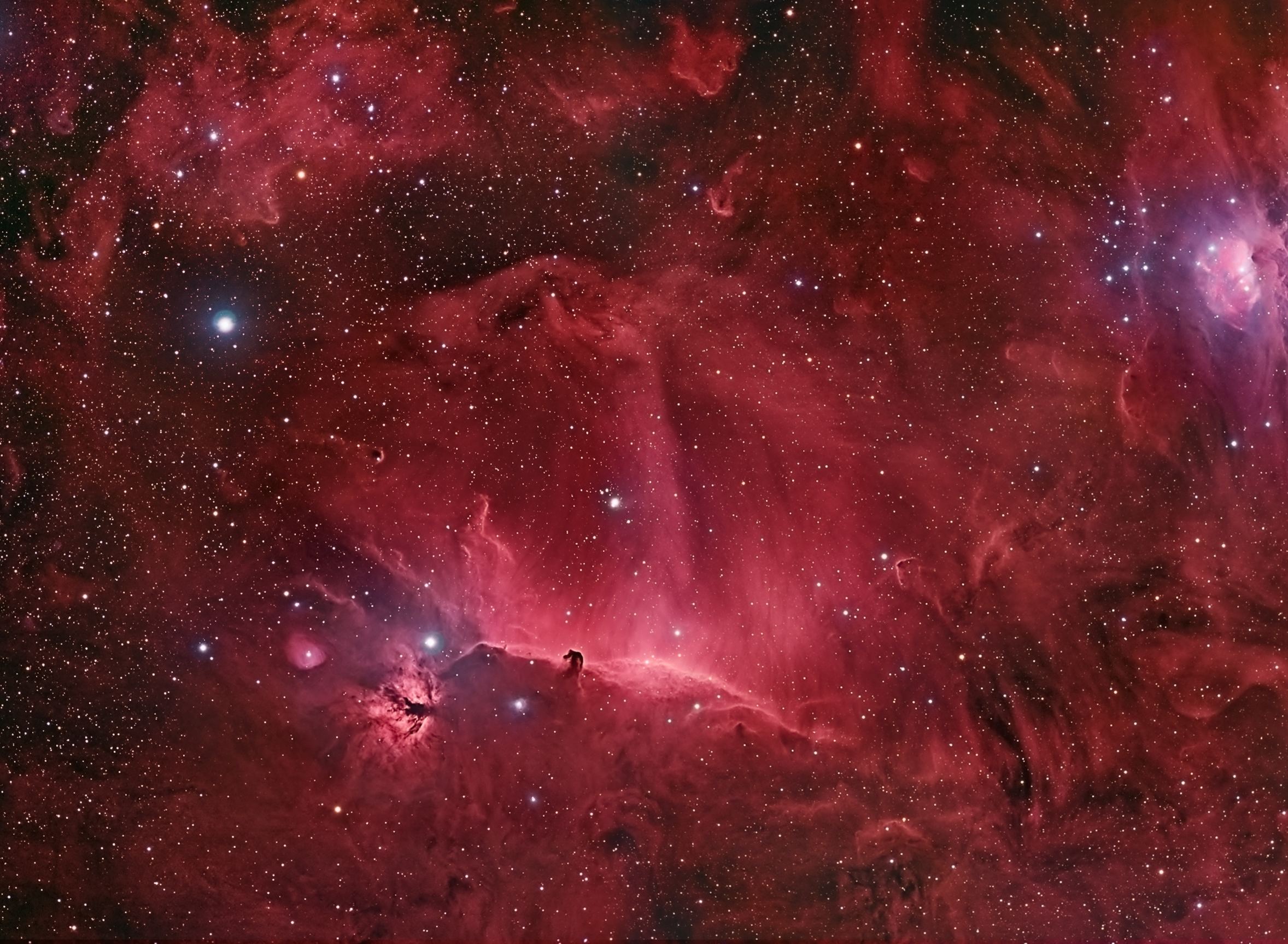
At the SFAA star party a couple nights ago on Mt Tam, the conditions were very clear and dark and we had a nice view of the Milky Way. With an excellent southern horizon, we could see all of Scorpius and Sagittarius and as my daughter and I were giving star tours to guests at the star party, I was happy to point out these two constellations and note that the center of the Milky Way was in the vicinity of the tail of Scorpius and the "teapot" of Sagittarius. This is called the "Galactic Center" and is the central bulge of the Milky Way Galaxy.
Looking toward the galactic center, however, you don't see a huge ball of light. That is because there is a massive dust cloud that lies between the Sun and the galactic center. Too bad for us, because it would be quite amazing to see the center of our own galaxy. Nonetheless, there is much richness in the sky near the galactic center and even in city lights you can begin to see some of that beauty if you use a pair of binoculars. Standard 7x35 or 10x50 binoculars can substantially increase the amount of light you can see, and that means you can begin to discern the stars and shapes of deep space objects such as the Lagoon Nebula or the Swan Nebula. Take out binoculars and point yourself south and see if you can start to see some of the wonders that are at the heart of the Milky Way.
24 August 2009


17 August 2009
Get involved: Astronomy events in August
San Francisco Amateur Astronomers (SFAA) are hosting two events in the coming days, both open to the public at no charge.
The monthl y meeting of the SFAA takes place on Wednesday evening August 19th at 7:30 pm at the Randall Museum in San Francisco. From the SFAA: "Jack Welch of the Robert Ferguson Observatory in Sonoma gives a presentation on how we measure time and how time measurement is handled in various astronomy and space situations. Welch will explain how our understanding of time measurement has changed as technology and theory have developed, and will explore some of the special challenges satellites and spacecraft have when it comes to timekeeping."
The monthly SFAA event on Mount Tamalpais in Marin features a speaker and a public Star Party. It takes place at the Mountain Theater on Mt. Tam on Saturday August 22nd at 8:30 pm (lecture) with the star party immediately following the lecture. From the SFAA: "Dr. Anthony Coloprete of NASA-Ames will fill us in on all the details of the LCROSS mission. Two spacecrafts are on their way to the moon, and the impending impact on October 9 will be visible even with small scopes from Earth. Why crash into the moon? Dr. Coloprete’s talk 'Prospecting for Water on the Moon' reveals all."
The SFAA welcomes all to their events each month. I hope to see you at one of these events.
The monthl
y meeting of the SFAA takes place on Wednesday evening August 19th at 7:30 pm at the Randall Museum in San Francisco. From the SFAA: "Jack Welch of the Robert Ferguson Observatory in Sonoma gives a presentation on how we measure time and how time measurement is handled in various astronomy and space situations. Welch will explain how our understanding of time measurement has changed as technology and theory have developed, and will explore some of the special challenges satellites and spacecraft have when it comes to timekeeping."The monthly SFAA event on Mount Tamalpais in Marin features a speaker and a public Star Party. It takes place at the Mountain Theater on Mt. Tam on Saturday August 22nd at 8:30 pm (lecture) with the star party immediately following the lecture. From the SFAA: "Dr. Anthony Coloprete of NASA-Ames will fill us in on all the details of the LCROSS mission. Two spacecrafts are on their way to the moon, and the impending impact on October 9 will be visible even with small scopes from Earth. Why crash into the moon? Dr. Coloprete’s talk 'Prospecting for Water on the Moon' reveals all."
The SFAA welcomes all to their events each month. I hope to see you at one of these events.
10 August 2009
Perseid Meteor Shower 2009
It's August and that means its time for the annual Perseid Meteor Shower, this year reaching its peak on the evening and through the morning of August 11-12. Meteors are visible just about any night of the year, but throughout the year there are periods of intense activity in the sky ("meteor showers") because the Earth travels through a point in its orbit where there is a higher amount of space dust, rocks and other particles that enter the atmosphere at tens of thousands of miles per hour and burn up, creating bright streaks across the sky.
The Perseid Meteor Shower is going to be harder to see in 2009 because of the bright Moon that rises at 10:40 pm in San Francisco. For the city dweller, however, the shower is not much worse because of the bright Moon, as our city lights obscure many meteors anyhow. So the best you can do is simply enjoy the shower the evening of August 11th from wherever you are in the city. Pick a darkened comfortable spot. Lay back on a blanket and point your feet to toward the north -east and look around the sky. As the evening wears on, the origination point ("radiant") of the meteor shower rises in the north-east. This area is near the constellations Perseus and Cassiopeia as shown in the illustration to the right.
This year there will be a possible jump in the number of meteors as the Earth passes through a denser-than-usual filament of dust from the remnants of comet Swift-Tuttle. That will happen around 1:00 am pacific time on the 12th, so if you are up late you might just see a more intense period of meteor activity. Throughout the entire evening, the Moon will remain the one bright light everyone cannot escape, so when it rises just point your gaze in another direction and keep your eyes on the sky. And stay warm!
If you want to see a good meteor shower this year that won't have moonlight in the way, look ahead to December 14th when the Geminids will peak at an even higher rate than the Perseids. However it will be considerably cooler and the weather is less predictable at that time.
The Perseid Meteor Shower is going to be harder to see in 2009 because of the bright Moon that rises at 10:40 pm in San Francisco. For the city dweller, however, the shower is not much worse because of the bright Moon, as our city lights obscure many meteors anyhow. So the best you can do is simply enjoy the shower the evening of August 11th from wherever you are in the city. Pick a darkened comfortable spot. Lay back on a blanket and point your feet to toward the north
-east and look around the sky. As the evening wears on, the origination point ("radiant") of the meteor shower rises in the north-east. This area is near the constellations Perseus and Cassiopeia as shown in the illustration to the right.This year there will be a possible jump in the number of meteors as the Earth passes through a denser-than-usual filament of dust from the remnants of comet Swift-Tuttle. That will happen around 1:00 am pacific time on the 12th, so if you are up late you might just see a more intense period of meteor activity. Throughout the entire evening, the Moon will remain the one bright light everyone cannot escape, so when it rises just point your gaze in another direction and keep your eyes on the sky. And stay warm!
If you want to see a good meteor shower this year that won't have moonlight in the way, look ahead to December 14th when the Geminids will peak at an even higher rate than the Perseids. However it will be considerably cooler and the weather is less predictable at that time.
08 August 2009
Get involved: AANC astronomy lectures and star party in September
 Save the date: September 12th in Millbrae (just south of San Francisco near SFO). The Astronomical Association of Northern California (AANC), along with the Astronomical Society of the Pacific (ASP), are sponsoring the AANC annual meeting and has designated Saturday September 12th as a day open to the public. The day will include lectures by expert astronomers and astrophysicists, solar viewing through telescopes during the day, brown bag workshops, exhibits by local astronomy clubs and dealers, and an evening star party. Families
  are welcome and children are admitted free. Check out the details on the AANC Annual Meeting 2009 website and register now. I'll be taking part throughout the day and I'll be supporting the evening Star Party as well. More on these topics soon.
24 July 2009
The Summer Triangle
One of the brightest objects in the nighttime sky each summer is called the Summer Triangle. Rather than being a single constellation, the Summer Triangle is an "asterism," a grouping of stars that make an interesting pattern but are not themselves a single constellation. The Summer Triangle is, as advertised, a very distinctive triangle of three very bright stars that form a 30-60 right triangle. The three bright stars are Vega, Deneb and Altair. With three stars at magnitude 0 or 1, the Summer Triangle shines through even light-polluted city skies.

If you have darker skies, the Summer Triangle is a quick guidepost to locating some of the most interesting objects you can see with binoculars or a telescope in the Milky Way. The image to the right is taken from the website of the Great Smoky Mountain Astronomical Society. I like their web images because they present a very easy-to-follow guide to the most interesting objects in the part of the Milky Way that passes through the Summer Triangle, including double stars, nebulae, star clusters and the patterns of the three constellations that include the three bright stars of the Summer Triangle: Lyra, Aquila and Cygnus. For another description of the same objects, try this page from the Royal Observatory in Greenwich.
Use your binoculars or a telescope - even if you are in a big city - and see how much of these constellations you can identify and how many of the interesting objects you can find lurking in their midst.
Amateur Astronomy on KALW Radio / SFAA Star Parties
 I like blogging about astronomy because I want to get the public motivated to spend a few minutes out under the stars instead of staying inside at night. To that end, I've been able to extend my reach by being a guest on KFOG radio from time to time. This week KALW, public radio at 91.7FM in San Francisco, broadcast a feature story on the San Francisco Amateur Astronomers at one of their Star Parties on Mt Tam. It's great radio and it gives you a good perspective on what you do at at Star Party. KALW also recorded a brief interview with yours truly talking about the night sky. I used to be a radio DJ years ago and it's a real pleasure to have the opportunity to get in front of a microphone and reach out to the public over that medium, be it on KFOG or KALW.
The next chance to meet the San Francisco Amateur Astronomers at a star party on Mt Tam is this Saturday night, July 25th. The evening opens at 8:30 pm with a lecture by Dr. Natalie Batalha of San Jose State, talking about a NASA mission called Kepler. The Kepler Mission is looking for habitable planets that are orbiting other stars in the Milky Way. After the lecture, the SFAA will have telescopes for public viewing of the heavens. Unfortunately I will miss the lecture and star party on Mt Tam this month, but fortunately I'll be near Lake Tahoe enjoying dark skies and hosting some star parties there. More on that in a future post.
22 July 2009
Total Solar Eclipse in Asia
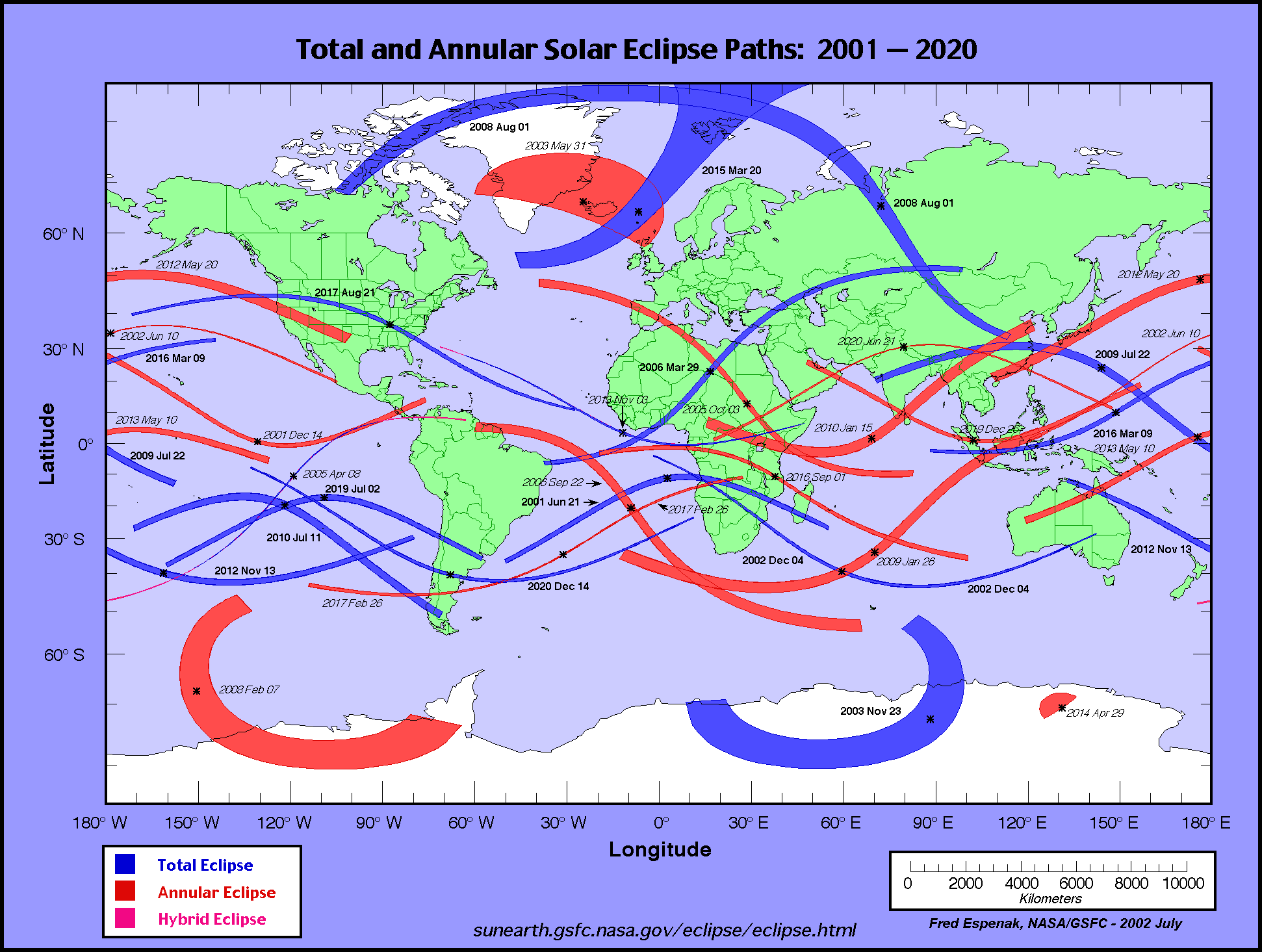
Today a large part of the eastern hemisphere experienced a solar eclipse, and along a narrow band of Earth viewers were well positioned to experience a Total Solar Eclipse, a rare and beautiful phenomenon. Unfortunately for most, the summer weather was miserable and the skies were cloudy - something that eclipse viewers (and eclipse chasers like me) don't want. Still, there was some limited visibility from a few observing sites. The tour group organized by Sky & Telescope Magazine saw a "murky" total solar eclipse. Better than none, I suppose.
For those of you wishing to see one closer to home, you'll have to wait until 2017 for a Total Solar Eclipse in the USA.
For those of you wishing to see one closer to home, you'll have to wait until 2017 for a Total Solar Eclipse in the USA.
15 July 2009
Subscribe to:
Posts (Atom)


 Posts
Posts