23 August 2010

Perspective of the Solar System

After weeks of foggy skies in San Francisco, the sky has started clearing, yielding spectacular sunsets and sky shows at Ocean Beach. I have been writing about (but not seeing much of) the amazing sight of the planets dancing across the evening sky. With the clear skies, the view was great, showcasing Venus and Mars very close together, with Saturn just to the lower right and the bright Zodiac start Spica (in Virgo) just to the upper left.

This configuration traces a curve in the sky and if you have a clear southern horizon you can "connect the dots" from this cluster of stars and planets to the south where bright Jupiter dominates the sky. Beyond that, the Moon is slicing across the lower southern sky, providing the observer with a nice visual of the Ecliptic, the line of the planets, Moon and Sun. This is a great way to visualize the path of the planets in the Solar System when you look out from our Earth-bound perspective.

Over the coming months, Mars and Saturn and eventually Venus fade, but the giant planet Jupiter will be dominating the Fall skies.

11 August 2010

Perseid Meteor Shower 2010

The Perseid Meteor Shower reaches its peak this week and the timing is very good for a fine display of meteors. Every year when the Perseids come around, the biggest concern is the Moon. Its beautiful light is a welcome sight to many, but for amateur astronomers and anyone wishing to see more than a few meteors, moonlight can ruin an otherwise-perfect evening of viewing. This year the Moon is very young during the Perseids and sets not long after sunset, leaving a dark sky for the shower.

The Perseids peak on the nights of Thursday 12th and Friday 13th, with best viewing on Thursday night / Friday morning. You can get detailed information on the Sky and Telescope website or on numerous other web resources.

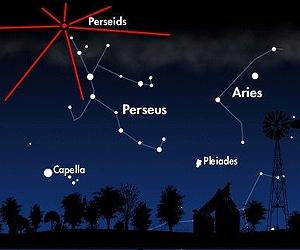
The best way to see the meteor shower is to find a dark location, give your eyes plenty of time to adapt to the darkness, and be prepared to stay up late (or get up early). Meteor showers are almost always best viewed after midnight when the Earth is powering directly into the meteor stream and the rate increases substantially. The Perseids appear to originate in the constellation Perseus which is in the east after midnight, but that does not mean you have to specifically look east to see the meteors. Lying on a blanket facing directly overhead gives you the most expansive view and you can see meteors coming from the east or passing overhead toward the west. Meteors are wonderful, fast, elusive wonders and you simply need to be warmly dressed, in a place where you can see as much of the sky as possible without light distractions, and patience. I wish you clear skies and a great night or two observing.

02 August 2010

Trio of Planets

The evening sky brings us a trio of planets in a close grouping this week. The bright beacon of light, Venus, shines brightly and moves quickly from night to night, especially by comparison to the slower-moving Mars and Saturn. The image shows the view on Sunday August 8th, so looking at this earlier in the week you will find Venus lower and to the right of the other two planets, and after the 8th you will see Venus glide to the upper left of the two planets. We are witnessing the motion of Venus along its orbit around the Sun, moving much more quickly from our vantage point on Earth than Mars and Saturn. Venus will continue to dominate the evening sky for many weeks to come.

16 July 2010

KFOG Podcast - July 16, 2010

I was in San Francisco this morning recording another podcast for the KFOG Morning Show Podcast Series. Morning Show Producer Irish Greg and I had a very spirited and lively conversation about planets, the Solar System, Star Parties, Iridium Flares, Dark Energy and Dark Matter. In a fast-paced 9-minute conversation we discuss everything from the phase of the Moon to the origin of the Universe. Get inspired to see the sky tonight: Click here to listen.

11 July 2010

A Must See: Four Planets and the Moon

This week the sky features four of the brightest planets in a beautiful lineup in the sunset sky. The illustration on the left, borrowed from Sky & Telescope Magazine, demonstrates how the planets all align themselves in a path across the sky known as the Ecliptic. This line in the sky, actually a gentle curve from west to east across the south part of the sky, is the plane of the Solar System as viewed from our observing platform on Earth. We see fast-moving Mercury close to the Sun, then Venus, Mars and Saturn, a most impressive line-up.

To set this into perspective, the young Moon emerges from the glare of the Sun on Tuesday 13th, moving somewhat parallel to the Ecliptic but each day a bit farther south of the Ecliptic. This is because the orbit of the Moon around the Earth is slightly inclined to the rest of the bodies in the Solar System. And as we just had a Total Solar Eclipse on Sunday, the Moon is following a path away from the Ecliptic into what is called the "descending node" south of the Ecliptic.

I will be talking about this at the California Academy of Sciences at their Nightlife event this Thursday in Golden Gate Park. If you are in or near San Francisco, please join me on the roof for Star Tours!

09 July 2010

Total Solar Eclipse 2010

One of the most dramatic spectacles of nature takes place Sunday July 11th, as the New Moon passes in front of the Sun and creates a Total Solar Eclipse over the South Pacific Ocean. This eclipse will be especially unique for those who travel to Easter Island to see it. As the shadow of the Moon sweeps across the ocean at speeds of up to 1000 miles per hour, the darkness will pass directly across Easter Island and the famous Moai, the large stone statues that are nearly 1000 years old.

I have experienced Total Solar Eclipses in the past and they are remarkable, not only for the brilliant image you see in the sky, but also for the dramatic changes in the environment you experience as the sky slowly darkens, the horizon changes color, the animals begin to react strangely, and the fellow eclipse-chasers react with great anticipation. Although I will not travel to this one, I plan to travel to one of the upcoming eclipses in the next few years.

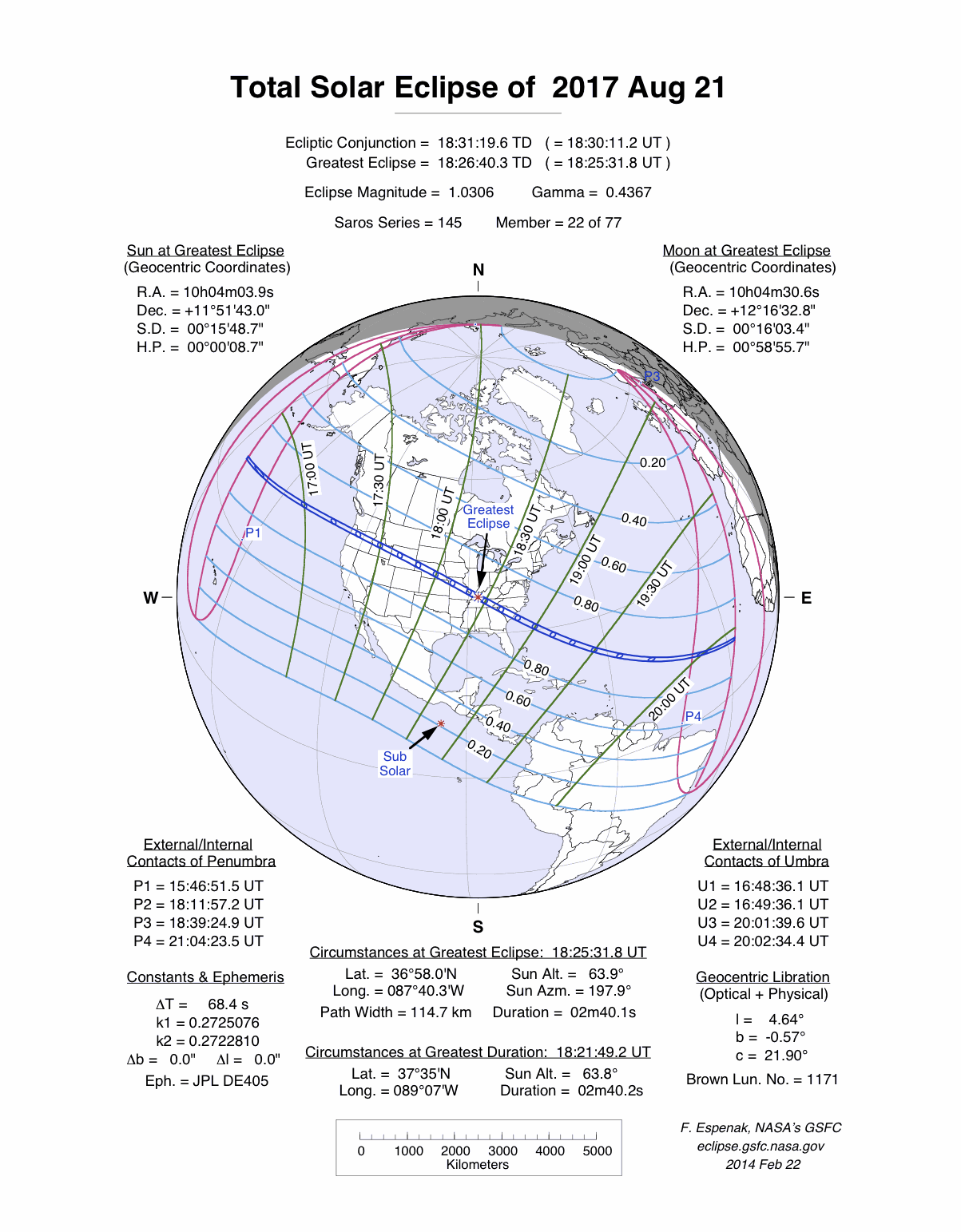
For those in the US who don't want to travel far, your next chance to experience at Total Solar Eclipse will be 2017.

05 July 2010

Star-and-Planet Drama

The evening sky over the next few weeks offers a study in the changes that take place in the sky along the path of the Moon and the path of the planets. This is exciting to watch and helps to unveil some of the intricacies of the Solar System, something you can see right from your own backyard. For quite a while now I have been particularly fond of sharing the path of the planets across the sky (the "Ecliptic") while conducting star parties and giving astronomy talks. I find that the ability to visualize this band across the sky is an important one for those who wish to have a basic understanding of the motion of the planets across the sky. And for several months the bright planets, a collection of bright stars, and the monthly sweep of the Moon across the sky have provided a perfect laboratory for learning. This month is no exception.

Shortly after sunset there is an excellent parade of planets and stars easily visible as the glare of dusk fades, starting with brilliant Venus in the west, and then in succession from west to south are Regulus, Mars, Saturn and Spica. These bright objects show the line of the Ecliptic.

At the end of this week there is a total solar eclipse (unfortunately not visible
from the San Francisco Bay Area). The eclipse comes at the middle of an Eclipse Season and as such, the Moon follows a descending path below the Ecliptic in the days that follow the eclipse, in particular from the 12th to the 17th of July. As it moves from day to day, it swoops just below the Ecliptic and makes a pleasant arc across the southern sky below Venus and Regulus, then Mars, then Saturn and then Spica.

And in addition, we are just coming into a period of time when fast-moving Venus has close encounters with the other planets and stars along the Ecliptic, starting with a close encounter of Regulus on the 9th of July. More drama to come in the next few weeks -- stay tuned!

19 June 2010

The Path That Leads to the Earth's Shadow

We are in an "Eclipse Season," a five week period of time when the Moon's orbit around the Earth is aligned in a way that the Full or New Moon crosses the path of the Earth around the Sun. When that happens, we experience a Lunar or Solar Eclipse and right now we have one of each coming up: a partial Lunar Eclipse on Saturday 26th, and a total Solar Eclipse on July 11th. The Solar Eclipse will not be visible from North America so we don't get a chance to experience that, but the Lunar Eclipse will be. More on that next week.
During an Eclipse Season, the Moon's position in the sky is special, as it is moving just above or just below the plane of the planets (the "Ecliptic") in the interval from New Moon to Full Moon. A few days ago as the Moon emerged from the evening glare waxing each evening, you could see it move just below Venus, then below Regulus and Mars, and now it is below Saturn and Spica, all objects on or near the Ecliptic. As it nears Full Moon and the Lunar Eclipse on the 26th, it is moving closer and closer to the Ecliptic and will intersect the Earth's shadow on the 26th.
I like to imagine that there is a dark spot in the sky where the Earth's shadow projects out into space. Every month as the Moon nears Full, it sweeps close to that spot. But only during an Eclipse Season -- every six or twelve months -- does it slip into the shadow of the Earth and display to all of us the curved shadow of the Earth. That is something to look forward to next weekend.