Showing posts with label Milky Way. Show all posts

19 August 2025

The Magic of the Milky Way

The Milky Way Galaxy
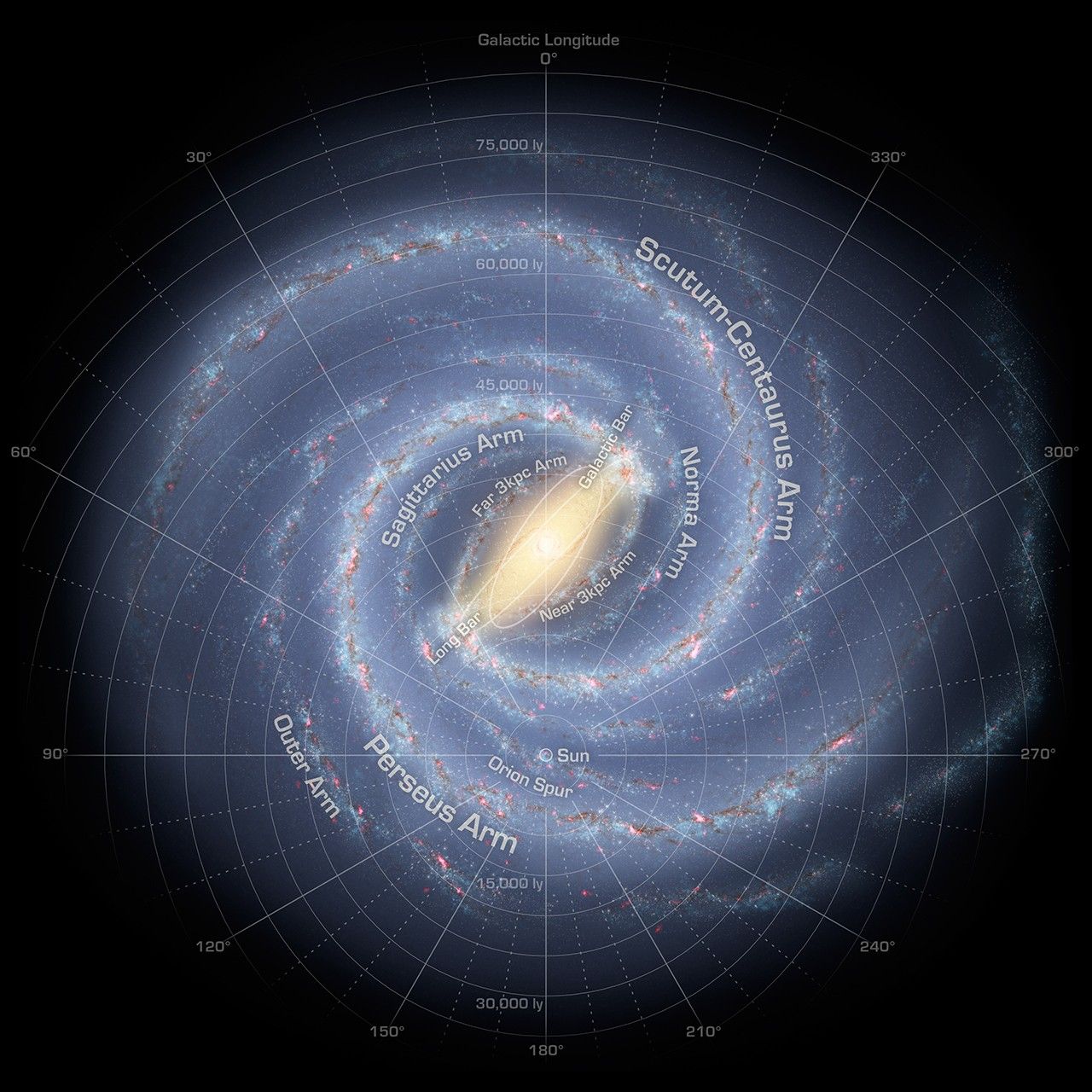
We live in an SBc galaxy, a Barred Spiral galaxy, according to the Hubble Sequence classification method. What does that mean? Well actually, it means we live in a very nice example of a galaxy in the Local Group of the Virgo Cluster in the Lanaikea Supercluster in the Universe. How's that for a mouthful? 

OK: we can make this simpler. The Milky Way is a lovely band of light that we can see in the night sky. And when we look up in the summertime, it's full of treasures to discover. We can see the spiral arms, the dark dust lanes, and the vast array of star clusters, nebulae, and more. 

In the August 2025 episode of the Translunar Podcast, I provide a tour of our own galaxy and a way to think about the band of light we see in the sky when we view the summer sky from a dark location. And I share some insights into how we categorize and classify galaxies. Savor the moment and happy listening (and viewing). 

Translunar Podcast, courtesy of the Volkssternwarte München, available anywhere you get your podcasts. 

Image courtesy of NASA

22 October 2020

Share the Night Sky - Broadcast on KPOO

During the recent Bay Area Science Festival, I had the privilege of sharing the night sky with DJ Marilynn and the listeners of KPOO during a special broadcast on Thursday evening October 22nd. Our hour-long broadcast features many different topics: 

  • How to find a good spot for stargazing in the city, and how to prepare for looking at the night sky. 
  • How to find planets such as Jupiter, Saturn and Mars this fall and winter, along with the constellation Sagittarius. 
  • How to find the Summer Triangle and connect it to the Milky Way. 
  • How the view of the sky changes when viewing from different places around the world. 
  • How to understand the motion of the constellations in the northern sky, featuring Cassiopeia and the North Star. 
  • How to enjoy a view of Orion the Hunter later in the evening. 
  • How to further your experience with the night sky. 

Click here to listen to the broadcast. 

Image courtesy of KPOO-FM.

31 May 2020

15 minutes about: Our Place in the Universe

How can we possibly comprehend our place in the universe? I discuss this topic frequently during star parties and enjoy sharing my thoughts about how we can relate to the universe in a more tangible way. I created a 15 minute talk about this as part of an innovative science talk series in Munich, 15x4 Knowledge. The talk covers the various 'levels of scale' that define our universe, from our home planet Earth through the Solar System, Milky Way galaxy, the Local Galactic Group, to the Laniakea Supercluster. As the name of the series suggests, four speakers give 15 minute talks in a single the evening and it was an honor to be a part of their program. More videos from 15x4 Munich can be found on YouTube.

Click here to view the video "15 minutes about: Our Place in the Universe."

14 October 2019

Cygnus and the Milky Way

Autumn brings us cooler evenings and earlier sunsets, but it’s not yet too uncomfortable to go outside and gaze up into the heavens for a look at our own galaxy, the Milky Way. The best way to enjoy this from a city setting is to get out to a place where you can lie flat on your back (on a blanket or lounge chair) and look directly overhead. In the evening the constellation Cygnus dominates the sky and is easy to find even with light pollution around you. Cygnus is also known as the Swan, as it resembles a giant swan flying gently toward the north-east and is also known as the Northern Cross, since its brightest stars outline a cross quite clearly. The brightest star of Cygnus is Deneb, a beautiful blue giant star that is one member of the Summer Triangle, an asterism that is made up of three of the brightest stars in the summer and fall skies. The diagram below shows the region of the sky directly overhead (zenith) with the three bright Summer Triangle stars identified in white, and the cross shape of Cygnus in purple.

Cygnus the Swan, or Northern Cross
Cygnus is directly in the band of stars of the Milky Way that we can see across the night sky. In dark conditions, the band of the Milky Way glows like a faint cloud but in the city that is unfortunately lost to light pollution. However, if you have binoculars or a telescope you can still enjoy the richness of the Milky Way by looking deeply into Cygnus where you will find many treasures that are quite accessible. I’ll cover some of those in a future post. For now, just see if you can get out and gaze up into Cygnus and into the elliptical arms of our own home galaxy. There are little gems and surprises awaiting you!

Image courtesy of Sky Safari.

21 July 2015

Southern Summer Skies

Facing South in the Summer
Facing south in the summer reveals a rich region of the night sky featuring the heart of the Milky Way and several excellent zodiac constellations. If you have a clear horizon to the south, the constellation Scorpius dominates the space with a long curving shape that winds around the horizon back to the tip of the tail of the scorpion, a feature called the Cat's Eyes, Shaula and Lesath.

For the next few months, Saturn is lurking next to the head of the scorpion, adding a bright highlight to the pattern. Scorpius and neighboring Sagittarius (to the east) are found directly in the center of the galaxy so there are numerous deep space objects to be found in the vicinity, making it one of the best places to enjoy with binoculars. You can move from spot to spot and never run out of interesting objects to see. This week the gibbous Moon drifts through that region of the sky so the darkness will be somewhat spoiled, but I find it good to get to know constellations when there is moonlight as well as when you have complete darkness. With moonlight you can learn the basic outline of the constellation, and without moonlight the deeper objects will emerge and reveal themselves to the careful viewer.

Image courtesy Sky & Telescope. 

20 July 2014

Binocular Astronomy

From an urban setting such as my home in San Francisco, I have a reasonable view of the night sky, knowing that from my own backyard I can see a good number of stars if I have clear skies and I am patient, allowing my eyes to dark adapt. In a city setting you are limited in the depth of the night sky you can experience by the ambient light in your exact setting, and the light pollution dispersed into the sky. But you can overcome these factors somewhat, by using binoculars.

Every time I am at a star party or astronomy gathering, in addition to a telescope I bring my binoculars. These are the fastest way to enhance your viewing whether you are in a dark sky or city setting. No matter what conditions you have, you will see deeper and will experience more richness in the night sky with binoculars. They are intuitive and require no special technical knowledge to use. You just point at a part of the sky and enjoy. Gary Seronik of Sky & Telescope publishes regular articles focused on binocular viewing and has an excellent resource book (I have a copy, of course) just for binocular viewing, Binocular Highlights. I highly recommend it.

Summer Milky Way in binoculars
During the summer months, point east and above to experience the richness of the Milky Way through binoculars. Even in city settings where the true outline of the Milky Way is not visible, binoculars will reveal some of that richness, exposing clusters and nebulae in the depths of the galaxy. I am particularly fond of the charts from the Great Smoky Mountain Astronomical Association for highlights in the summer galactic zone.

My old Celestron 10x50 binoculars have served me well for years and I carry them with me virtually everywhere I go. You should consider the same.

Image courtesy garyseronik.com.

05 March 2014

Moon and Winter Stars and Star Clusters

Moon visits the Winter Circle
The March evening sky features the bold constellations and bright stars of Orion, Gemini, Taurus, Canis Major and Canis Minor. Jupiter is currently occupying a prominent position and this week the Moon passes through this rich part of the sky, enhancing the view with its close encounters with stars and star clusters. On March 7th the Moon will be passing through the Hyades star cluster and two days later through the band of the Milky Way between Orion and Gemini. If the weather permits, take in the view and watch the Moon make its grand procession through the Winter Circle. Binoculars will enhance the view.

Image courtesy of Sky & Telescope.

27 October 2013

The Royal Sky


Every Fall, the royalty of the sky rises in the north-east and showcases a very fine part of the sky that includes the outer reaches of the band of the Milky Way, a galactic treasure, and a few easy-to-spot patterns that are easily visible in the night sky.

The Royal Sky
The trio includes Cepheus (the King), Cassiopeia (the Queen), and Andromeda (the Princess). In the early evenings this time of year, they are in a line from nearly due North toward due East, and the middle of these three constellations is quite bright and easy to locate in the sky. Over the course of the evening, they gradually shift position, spiraling out from the north circumpolar region of the sky toward the zenith, following closely the Great Square of Pegasus (of which Andromeda shares a corner star, Alpheratz).

I enjoy looking at this region through binoculars, with the outer reaches of the Milky Way visible in and around Cassiopeia, and of course the treasure of this part of the sky, the Andromeda Galaxy (M31).  Take some time to enjoy this royal corner of the night sky, brimming with discoveries small and large. 

Image courtesy of Sky Safari.

31 August 2013

A Sea of Deep Space Objects

The Galactic Center
The waning days of Summer are an excellent time to enjoy a view into the heart of the Milky Way Galaxy. We observe our own galaxy all around us in the night sky, and if you are in a reasonably dark location, you can see the band of stars that are the spiral arms of our own galaxy stretch across the sky. At this time of year, as the sky darkens after sunset, the Milky Way stretches high overhead, touching the southern horizon at the constellation Sagittarius. In fact, when you look due south toward that very constellation, you are looking toward the center of the galaxy. Not surprisingly, you also can see a lot of beautiful deep space objects, and with a pair of binoculars you can see many interesting objects, from clusters of stars to nebulae. The diagram gives you an idea of the richness of this part of the sky and galaxy, and even in city lights you will still be able to spot many of these objects. A telescope is fine to use as well, but I find that binoculars give you a big picture and are quite good for seeing the colors and breadth of many of the big nebulae in and around Sagittarius. 

Six months from now, as the Earth swings around the Sun and our view of the night sky has shifted, we'll be pointing the opposite direction toward the 'antipode' of the Milky Way Galaxy, a much less interesting part of the sky (but still cosmically significant). So enjoy Sagittarius and the center of the galaxy while you can.

25 August 2012

The Galactic Center: Staring Into the Heart of the Milky Way

Summer is prime time to look into the heavens and touch the wonder of the Galactic Center, the heart of our own Milky Way galaxy. Two bright constellations guide you to the center of the Milky Way, Scorpius and Sagittarius, which are easy to spot due south each evening shortly after sunset.

The Galactic Center
Our own Sun and Solar System occupy their special place 30,000 light years from the center of the Milky Way, and as we look out and around us into space, we view our own galaxy from within, along the spiral arms and toward the center. Many have seen the lovely band of the Milky Way when camping or far away from city lights, but the faint river of light is all but invisible in any urban area. Nonetheless, with binoculars, you can see deeper into the sky and discover some of the deep space wonders and faint objects that are visible between our own location and the center of the galaxy, an area full of star clusters and nebulae. So I encourage everyone to get a pair of binoculars, face south, and using the star chart (above) as a guide, aim between Scorpius and Sagittarius and meander from there upwards. You will encounter the Lagoon Nebula and the nearby Trifid Nebula, easily visible in city lights if you use a telescope or binoculars, and many more Messier Objects, the fuzzy blobs that dot the sky near the Galactic Center.

In six months, when the Earth has traveled half-way around the Sun, we'll be able to look in the opposite direction, toward the Galactic Anticenter, as I have described in a previous blog post. That is interesting to consider, but more exciting is the Summer when we can enjoy our own galaxy's finest wonders on full display.

Here's a link to an image of the Galactic Center on Sky & Telescope's website.

Image courtesy SkySafari.

09 February 2012

Auriga and Capella: the Galactic Anticenter

High overhead in the winter sky is the distinctive constellation Auriga the Charioteer. This is a bright constellation, visible even with city lights, punctuated by the 6th brightest star in the night sky, Capella. To the casual viewer, Auriga appears to be a pentagon in the sky, and in winter it is nearly directly overhead as night sets in. Depending upon the source, the constellation Auriga is described as the actual Charioteer holding a goat, or just the shape of his pointed  helmet. The star name Capella is in fact Latin for 'small goat.'

Auriga has the distinction of being located in the direction of the Galactic Anticenter. What is an anticenter? It is the point in the night sky that is opposite the Galactic Center, of course :-)  The center of the Milky Way Galaxy is located in the direction of the constellation Sagittarius, a dominant summertime constellation. So not surprising, in the winter time when we are looking the 'other direction' in the sky, we find ourselves staring out into space directly out of our Milky Way Galaxy.

The bright star Capella is relatively close to Earth, 42 light years away. It shines brightly in the winter sky, making Auriga easy to locate. A fascinating fact is that the star Capella is not one star, but a four-star system made up of two binary stars. That means, that the four stars are broken into two pairs of binary star systems. Two of them are big stars, 10 times the size of our Sun. The other two are quite small and faint, so when you see Capella you are primarily seeing the two bigger stars. Some binary star systems can be seen as separate stars in small telescopes or binoculars, but the two bigger stars in the Capella system are too close to see as separate objects.

Try to locate Auriga and Capella tonight and savor the fact that you are staring out of the Milky Way into the vastness of space far away from our home galaxy.
16 September 2011

KFOG Podcast - Sep 16, 2011

Today's discussion with KFOG's Irish Greg features (a) the Milky Way in the Autumn Sky, (b) Fireball across Southern California, (c) new planets being discovered, and (d) the Supernova in the Pinwheel Galaxy. As always, it's good fun and in exactly 8 minutes, you'll be a more informed citizen scientist. Click here to listen.

21 August 2011

Seeing the Milky Way in City Skies

Summers bring pleasant viewing and a wealth of richness in the heavens. As the Summer Triangle rises and dominates the night sky, two of my favorite Zodiac constellations, Scorpius and Sagittarius, are visible deep in the southern sky. These big, bold constellations combine with the Summer Triangle to guide the urban star-gazer to the Milky Way.

For anyone who has seen the spectacle of the Milky Way in dark skies, you know just how profound this band of light looks as we view our own galaxy from within. And I know how disappointing it is after a few days in dark skies, to return to the city and realize that the beauty of the Milky Way is missing. But don't despair, for even in urban settings, you can still see many of the wonders of the Milky Way. To do this, you need to use a telescope or binoculars. Using Scorpius and Sagittarius as your anchor on the southern horizon, and the Summer Triangle high above, point the telescope or binoculars into the sky and move slowly from the south slowly overhead. You are looking into the Milky Way, and with the magnification and light-gathering of a telescope or binoculars, you cut through the glow of the city lights and enhance the light from space. And that will be a rewarding moment under the sky. No need for a fancy star chart or an iPhone app. All you need is a sense of wonder and a comfortable chair.

25 April 2011

Viewing Gemini and a Deep Space Gem, M35

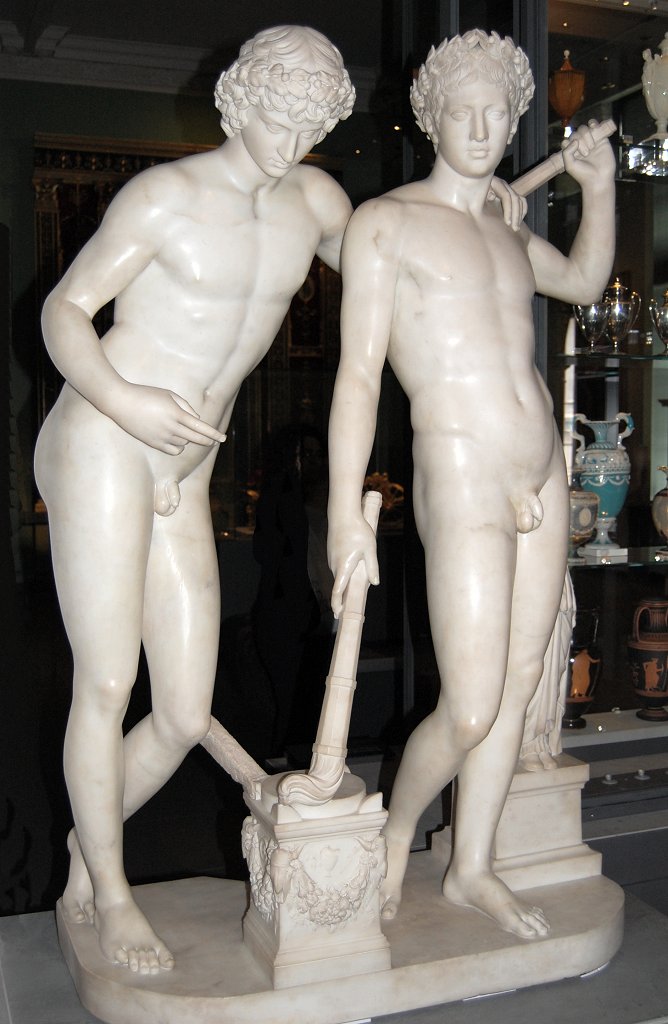
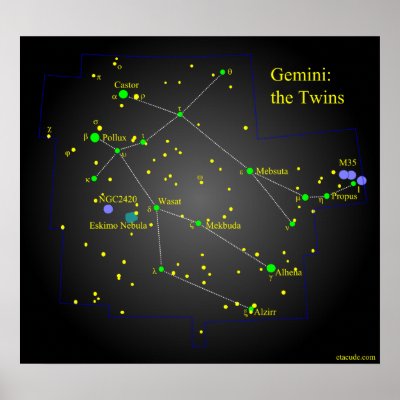
Spring skies are dominated by an array of bright stars and distinctive constellations. In April and May, the zodiac constellation Gemini dominates the view to the west, gracing the sky with the twin stars Castor and Pollux, and guiding the curious observer toward a gem in the river of the Milky Way, which flows across the legs of the twin brothers.

The star pattern of Gemini is of the brothers Castor and Pollux standing side by side. The bright twin stars represent the heads of the twins, and the stars that are below Castor and Pollux trace out their bodies, arms, legs and even a foot. An advantage to viewing Gemini in the Spring is that the brothers are standing upright and are easy to see, whereas in other times of the year when Gemini is visible, the brothers are not in an easy-to-spot orientation, or are directly overhead, a difficult thing to see.

If you have binoculars, you can try to spot a very faint but beautiful star cluster called M35 near the foot of Castor, the twin on the right-hand side of the pair. You will need a star chart (click on the image above, or try this fine star chart) to locate this small circle of stars but if you have patience and a dark viewing location, you will know you have found it because M35 seems to glow in the view of your binoculars compared to the stars around it. The stars in M35 are quite distant, nearly 3000 light-years away (but still within the Milky Way galaxy).

Happy viewing, and good luck with M35!

22 February 2011

Seeing Summer in Winter - Scorpius and Sagittarius

The early morning sky this week holds some treasures for star gazers. As the view of the heavens changes from season to season, we have a chance to see the symmetry of our sky by looking south-east in the morning. In winter, we see the majestic winter sky in the evening, but by early morning we see the summer sky! How is this possible? Every 12 hours as the Earth rotates on its axis, we face the different constellations and in fact see the "opposite" season in the morning. This week, as the old Moon passes through the summer constellations of Scorpius and Sagittarius, it accentuates the rich beauty of these two constellations, both of which contain many treasures for the unaided eye as well as for those who wish to get out their binoculars for a closer look.

Sagittarius is located in same direction as the center of the Milky Way, and Scorpius is just next to this, so both contain a richness of nebulae and star clusters that are easy to find in binoculars. It's worth the extra 2 minutes in the morning to take a look if you can get outside before the first light of dawn, before 6:00 am in San Francisco.

12 October 2010

An Elusive Comet in Urban Skies: Hunting for Hartley 2

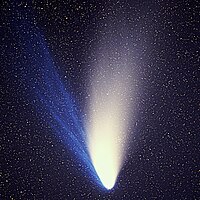
Comets can be bold and brash, streaking across the sky like Hale-Bopp in 1997 (see image on right), a comet that was visible even in light-polluted urban areas. Comets can be more humble but then unexpectedly brighten, as did Comet Holmes in 2007. This year marks the return of periodic Comet Hartley 2, a small but frequent visitor to the inner Solar System that is making a fairly close pass to the Earth (11 million miles) on October 20th. Because of the bright Moon on October 20th, this and last week mark the best chances to see the comet because the Moon is young and not brightening the sky. So I took a look last week and again this week to see if I could spot this elusive comet from a city location (last week in a suburb of Frankfurt, Germany and this week from my home in San Francisco).

I hunted quite a while on both occasions, using this very helpful map from Sky and Telescope Magazine. In fact, S&T has been running updates as viewers report seeing Comet Hartley 2 with binoculars. However, it seems that to see Comet Hartley 2 you need a location with very dark skies. I can attest to this, having twice tried and failed to discern the comet from the surrounding stars.

However, all is not lost. Searching for Hartley 2 requires you to find Cassiopeia, Perseus and Auriga, three very nice constellations that grace the Fall and Winter skies. While searching the path of the comet, you encounter a range of deep space objects near and between Cassiopeia and Perseus, and tonight the view was quite good. So even though city lights may have drowned out the faint comet, I enjoyed my first good look at the Double Cluster in Perseus and other celestial gems in the spiral arm of the Milky Way that is beyond Cassiopeia.

I recommend a good jacket, a comfortable chair or blanket, a few minutes patience, the S&T sky map, and binoculars. No matter whether your hunt for Comet Hartley 2 is a success or not, you will be glad you made the effort.

10 September 2010

KFOG Podcast - September 10, 2010

Another fun visit with Irish Greg of the KFOG Morning Show, today featuring a discussion of constellations to see this time of year (Sagittarius, Scorpius, The Summer Triangle) and the difference between an asterism and a constellation, plus deep-space objects you can see in the Milky Way with an ordinary pair of binoculars. And the latest happenings with the Moon and Venus, and an update on a great star party and lecture this weekend. All in 7 short minutes! Click here to listen.

24 August 2009

The Milky Way and the Galactic Center

At the SFAA star party a couple nights ago on Mt Tam, the conditions were very clear and dark and we had a nice view of the Milky Way. With an excellent southern horizon, we could see all of Scorpius and Sagittarius and as my daughter and I were giving star tours to guests at the star party, I was happy to point out these two constellations and note that the center of the Milky Way was in the vicinity of the tail of Scorpius and the "teapot" of Sagittarius. This is called the "Galactic Center" and is the central bulge of the Milky Way Galaxy.

Looking toward the galactic center, however, you don't see a huge ball of light. That is because there is a massive dust cloud that lies between the Sun and the galactic center. Too bad for us, because it would be quite amazing to see the center of our own galaxy. Nonetheless, there is much richness in the sky near the galactic center and even in city lights you can begin to see some of that beauty if you use a pair of binoculars. Standard 7x35 or 10x50 binoculars can substantially increase the amount of light you can see, and that means you can begin to discern the stars and shapes of deep space objects such as the Lagoon Nebula or the Swan Nebula. Take out binoculars and point yourself south and see if you can start to see some of the wonders that are at the heart of the Milky Way.