This April, as the weather has improved and I've been conducting star parties, I've found myself focusing on some striking pairs of planets and stars that punctuate the night sky this spring. The pairs are all located in the Zodiac, the band across the sky that houses the well-known
12 signs, and also the planets and the Moon. The pairs of planets and stars are easy to find, and when you find them, you get a big picture of the band of the Zodiac, with the planets in our Solar System superimposed upon that band.
Shortly after sunset, it is quite easy to find Mars, shining a bright orange color almost directly overhead, and just next to it, the bright blue-white star Regulus in the constellation
Leo. Starting from this point and looking North-West toward the point of sunset, you will encounter the twin stars Castor and Pollux, the two brightest stars in the constellation
Gemini. And starting again at Mars, if you look toward the South-East, you will find the next pair along the Zodiac, the planet Saturn and the bright star
Spica in the constellation Virgo.

If you trace a line from Saturn through Mars, and then toward the North-West through Gemini and to the brilliant planet Venus, you will be tracing out the path of the planets along the night sky, through the band of constellations we call the Zodiac,
and along a line in space called the Ecliptic. It's a great way to get acquainted with the heart of our night sky, and this week you can watch the Moon gliding through the same space, as it makes its 29 1/2 day journey around our home planet.
Images courtesy of Sky & Telescope.


 If you trace a line from Saturn through Mars, and then toward the North-West through Gemini and to the brilliant planet Venus, you will be tracing out the path of the planets along the night sky, through the band of constellations we call the Zodiac, and along a line in space called the Ecliptic. It's a great way to get acquainted with the heart of our night sky, and this week you can watch the Moon gliding through the same space, as it makes its 29 1/2 day journey around our home planet.
 The ecliptic is the plane of the Solar System, the imaginary line across the sky that marks the orbits of the planets and the Moon. In a planetarium this can easily be shown, but under the heavens it is daunting to visualize this. I use a laser pointer to show the path across the sky, and that helps to visualize this, but right now the skies are cooperating to make this a bit easier for those of you without an amateur astronomer and a laser pointer :-)
 Gemini is one of the finest constellations you can see during the winter months, easy to spot because it traverses the highest spot in the sky (the zenith) and features two bright stars, the twins Castor and Pollux. These two stars are well known because they symbolize the heads of the mythical twins. The stars that make up the rest of the bodies of the twins are less bright and require slightly darker conditions than we will have this week, but I provide an image nonetheless so you can see the rest of the stars when conditions permit.
 sweeps through this busy part of the sky, passing slightly south of Gemini, Mars and later this week the bright star Regulus in the constellation Leo. The bright Moon will drown out the background stars of these otherwise bright constellations, but the prominent stars Castor, Pollux and Regulus, along with Mars, will shine beside the waxing gibbous Moon. Binoculars or a telescope are a good idea if you want to see this close up!
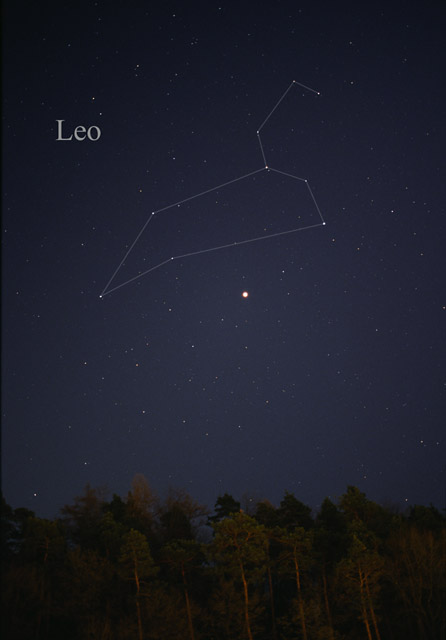 Leo is one of the twelve zodiac constellations, the name "zodiac" sharing its origin with the word "zoo" -- appropriate for the ring of mythical animals found in the sky. Leo is a very easy-to-locate constellation because it has one very bright star (Regulus) and quite a few moderately bright stars in a distinctive pattern that resembles a lion. The image at left shows the general outline of the stars in Leo, with the sickle (or backwards question mark) at the head of the lion, something that is easily identifiable as Leo rises in the east in the winter. For the coming months, it will be appearing higher in the east and traversing nearly overhead throughout the evening.


 Posts
Posts


