Showing posts with label Gemini. Show all posts

22 January 2020

The Spectacular Winter Circle

Winter brings out the best in the night sky. Some of the finest stars in our galaxy are concentrated in a region of the sky that shines with an intensity that you just can't miss on a clear night. A collection of extremely bright stars form a nice shape that is fun to look for, the Winter Circle. This asterism features 5 of the 8 brightest stars in the entire night sky, and in total 7 very bright stars that glow in the south on long winter nights.
The Winter Circle

Given that all of the stars in the Winter Circle are bright, this is a relatively easy target for city dwellers who might not normally pay attention to the night sky. The stars are part of six different constellations covering a fairly significant part of the winter sky. January evenings feature the Winter Circle moving gradually from east to west across the southern horizon. Given the span of this asterism from the lowest point at the star Sirius (see diagram) to the highest point at the star Capella, you will need a fairly clear view across the southern sky. For me, it's easy to spot one or two constellations wherever I am, but seeing all six constellations and all 7 of the bright stars in the circle requires that I have a good horizon and not much else blocking the way.

Most people can quickly and easily find the constellation Orion, and from there you can start your trip around the circle. Rigel is a blue supergiant star that is one of the kneecaps of the hunter Orion, and it is one of my favorite stars because of the intensity and color. Orion's 'belt' can help you find two other members of the circle, by following the belt up toward Aldeberan and down toward Sirius. The other stars are then easy to find looking up and left of Orion toward Gemini, Auriga and Procyon.

Finding a wide open space on a clear winter night where the grandeur of the Winter Circle is on full display is one of my favorite things. The stars are rich and intense, and the utter size of the circle make the viewing of this amazing pattern worth the effort. Dress warm and savor the moment. You will be glad you made the effort.

Image courtesy of SkySafari.

Update: good article from Sky & Telescope on the Winter Circle. They call it the Winter Hexagon.

20 May 2014

Four Planets at Dusk

As the Sun sets this week, we have a very nice view of four planets visible in an arc that spans the entire sky. About 45 minutes after sunset the sky is nicely fading to dark (around 8:45 to 9:00 here in San Francisco) and the four brightest objects in the sky take the stage, spanning from the northwest to the southeast. Nearest to the Sun is elusive Mercury in the northwest evening sky above the sunset point. Looking up and to the left you can't miss brilliant Jupiter, gradually dropping lower and lower in the evening sky in the constellation Gemini. Higher up and farther to the left of Jupiter is orange Mars, shining among the bright stars of Virgo. And finally in the opposite side of the sky from sunset is Saturn, emerging from opposition in the southeast part of the sky among the faint stars of Libra. From horizon to horizon the planets dominate the dusk sky, so if you have a good horizon step outside as the sky is fading and enjoy the four bright pinpoints of light that mark the path of the Solar System. In the fading light of dusk these are the first four objects you will be able to easily spot.

More details on Sky & Telescope and on Earth Sky.

05 March 2014

Moon and Winter Stars and Star Clusters

Moon visits the Winter Circle
The March evening sky features the bold constellations and bright stars of Orion, Gemini, Taurus, Canis Major and Canis Minor. Jupiter is currently occupying a prominent position and this week the Moon passes through this rich part of the sky, enhancing the view with its close encounters with stars and star clusters. On March 7th the Moon will be passing through the Hyades star cluster and two days later through the band of the Milky Way between Orion and Gemini. If the weather permits, take in the view and watch the Moon make its grand procession through the Winter Circle. Binoculars will enhance the view.

Image courtesy of Sky & Telescope.

02 June 2013

Transitions in the Evening Twilight

Every night, the sky appears a bit different to us, and in June as the long days of summer unfold, the sunset sky changes more rapidly than usual. The trio of planets that dominated dusk are now a pair, as Mercury and Venus climb higher into the west, and the bright stars and constellations of winter rapidly fade from view.

June's evening sky
The bright twin stars Castor and Pollux in the constellation Gemini are dropping gradually into the western sky after sunset, and the later and later onset of darkness combine with the change in position to speed these two stars out of view over the coming days. As they are lower and lower each night, Venus and Mercury will move higher each night and over the next 3 weeks, they will move closer to each other.

As you watch the changing landscape in June, take note of the gradual slowing in the onset of darkness as we approach the summer solstice later this month. The evening sky is a beautiful place to see transitions, and the visiting planets this month provide a fine guideline for this.

07 January 2013

Alignments in the City Sky

Jupiter, Orion, and Sirius
I am viewing the sky this evening from one of the most densely populated urban areas, Manhattan. Looking up at the night sky here, you can't see many faint stars, but you can still see plenty of the brighter ones. Tonight looking toward the south, I was easily able to spot the fantastic alignment of Orion's belt, pointing downward toward the brightest star in the sky, Sirius, and pointing upward to the brightest planet in the sky in the evening, Jupiter. As Jupiter gradually moves in its orbit around the Sun, it will soon move out of alignment with Sirius, Orion's belt, and the bright star Aldeberan in the constellation Taurus. By the middle of 2013, Jupiter will be well on its way to the next sign in the Zodiac, Gemini. But for the coming weeks, you can enjoy the bright celestial alignment that can been seen from just about any location on Earth, even in the middle of an urban jungle such as NYC.

Image courtesy of Sky Safari.

29 April 2012

Planet and Star Pairs Line the Sky

This April, as the weather has improved and I've been conducting star parties, I've found myself focusing on some striking pairs of planets and stars that punctuate the night sky this spring. The pairs are all located in the Zodiac, the band across the sky that houses the well-known 12 signs, and also the planets and the Moon. The pairs of planets and stars are easy to find, and when you find them, you get a big picture of the band of the Zodiac, with the planets in our Solar System superimposed upon that band.

Shortly after sunset, it is quite easy to find Mars, shining a bright orange color almost directly overhead, and just next to it, the bright blue-white star Regulus in the constellation Leo. Starting from this point and looking North-West toward the point of sunset, you will encounter the twin stars Castor and Pollux, the two brightest stars in the constellation Gemini. And starting again at Mars, if you look toward the South-East, you will find the next pair along the Zodiac, the planet Saturn and the bright star Spica in the constellation Virgo.

If you trace a line from Saturn through Mars, and then toward the North-West through Gemini and to the brilliant planet Venus, you will be tracing out the path of the planets along the night sky, through the band of constellations we call the Zodiac, and along a line in space called the Ecliptic. It's a great way to get acquainted with the heart of our night sky, and this week you can watch the Moon gliding through the same space, as it makes its 29 1/2 day journey around our home planet.

Images courtesy of Sky & Telescope.

13 January 2012

Planets wandering through the Zodiac

I've been fascinated by the movement of planets through the zodiac lately, showing this to guests at star parties and when I give talks at the California Academy of Sciences. Jupiter, being the dominant planet in the evening sky, brings my attention to the constellation Aries, which from an urban setting is two somewhat-bright stars paired next to blazing Jupiter. Following the ecliptic toward the east, you find a series of beautiful and bright constellations including Taurus, Gemini and Leo. By the time Leo is rising in the late evening, Mars rises with it, a distinctive orange-red color in contrast to the white and blue-white stars of Leo. By early morning when I first look outside, Virgo has risen, and along with it, Saturn.

Jupiter has a wonderful pattern of travel through the zodiac, moving one 'sign' per year as we observe it in its 12-year long journey around the Sun, seeing the slowly changing backdrop of stars along the ecliptic. By stark contrast, Mars flits rapidly from one constellation to the next, out of Leo and into Virgo in the coming weeks. And by contrast in the other way, Saturn lumbers along gradually changing zodiac position every 2 1/2 years, moving from Virgo at present to Libra in 2014.

EarthSky has a nice writeup on seeing all 5 visible planets in January. Enjoy the month and get outside if it's not too cold. As for me, I've been entranced by the clear nights here in San Francisco and look forward to the ongoing winter skies and the bold bright planets that punctuate the view.

Image courtesy Sky and Telescope.

13 December 2011

Geminid Meteor Shower 2011

The Geminids peak the nights of December 13th and 14th this year, one of the better meteor showers of the year. Unfortunately for 2011, most of the Geminids will be nearly invisible due to the very bright Moon that dominates the late night and early morning sky, when the Geminids are at their best.

The effect of a bright Moon on a meteor shower was vividly illustrated to me during the Total Lunar Eclipse a few days ago. I was at Ocean Beach on the west coast of San Francisco for the eclipse in the early morning hours. Facing west, Gemini was directly in front of us, dominating the western sky. As the brightness of the Moon faded, we began to notice meteors -- we were seeing some very early Geminid meteors, facing the radiant directly. I was very surprised at the stark contrast in meteor visibility from Full Moon before the eclipse started, to an ever-increasing amount of meteors over a very short period of time as the Moon, in effect, when through all of its phases in about 60 minutes. It reaffirms for me the huge difference a moonlit night makes when watching a meteor shower.

Although the meteors will be diminished for the Geminid Meteor Shower in 2011, I'll still take a look, since a big shower like this has plenty of bright meteors that pierce the night despite moonlight. If you want to read more about the Geminids, check out this interesting article about the Geminids radiant, from Earth Sky, from the LA Times, or this one from NASA Science News.

Image courtesy EarthSky.

03 June 2011

Twin Stars and Moon in the West

As the days lengthen and the sky stays lit well into the evening, many familiar constellations are rapidly slipping out of view. The bright twin stars of Gemini, Castor and Pollux, are fading fast and will soon be gone from the night sky. Enjoy a few days of this sight, with the addition of a fine young Moon in the sunset sky this weekend.

25 April 2011

Viewing Gemini and a Deep Space Gem, M35

Spring skies are dominated by an array of bright stars and distinctive constellations. In April and May, the zodiac constellation Gemini dominates the view to the west, gracing the sky with the twin stars Castor and Pollux, and guiding the curious observer toward a gem in the river of the Milky Way, which flows across the legs of the twin brothers.

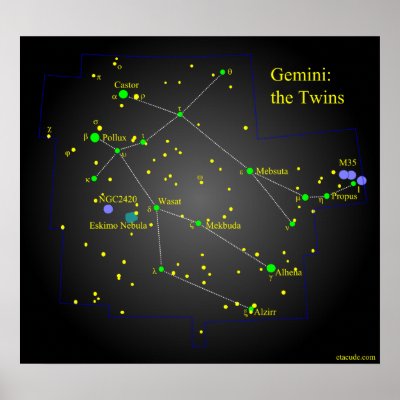
The star pattern of Gemini is of the brothers Castor and Pollux standing side by side. The bright twin stars represent the heads of the twins, and the stars that are below Castor and Pollux trace out their bodies, arms, legs and even a foot. An advantage to viewing Gemini in the Spring is that the brothers are standing upright and are easy to see, whereas in other times of the year when Gemini is visible, the brothers are not in an easy-to-spot orientation, or are directly overhead, a difficult thing to see.

If you have binoculars, you can try to spot a very faint but beautiful star cluster called M35 near the foot of Castor, the twin on the right-hand side of the pair. You will need a star chart (click on the image above, or try this fine star chart) to locate this small circle of stars but if you have patience and a dark viewing location, you will know you have found it because M35 seems to glow in the view of your binoculars compared to the stars around it. The stars in M35 are quite distant, nearly 3000 light-years away (but still within the Milky Way galaxy).

Happy viewing, and good luck with M35!

08 December 2010

Geminid Meteor Shower 2010

One of the best Meteor Showers of the year takes place in favorable conditions on Monday night December 13th into the morning hours of December 14th. The shower is called the Geminids, named after the constellation Gemini. The Geminids appear to originate from the constellation Gemini which rises shortly after sunset and is high in the sky around midnight. This point in the sky is called the radiant, and if you trace the paths of the meteors backwards, they will all converge in this point.

Meteor showers generally get better late into the night because the Earth is rotated in the direction of its orbit around the Sun and consequently we encounter a higher number of meteors, on average. This is certainly true for the Geminids, and in dark conditions after midnight you might see 1 or even 2 meteors a minute. Being winter, you have to really prepare for this by dressing extremely well for your local conditions. I plan to get up early and look for Geminids in the early morning hours of Tuesday 14th, since the Sun does not impact the viewing until after 6:00 am.

This year is particularly favorable for the Geminids because the Moon is at First Quarter and will not be a factor after midnight. Stay warm and enjoy the show!

Image courtesy of Earth Sky.

11 June 2010

Heavenly Line-Up

Over the past months the evening sky has been graced by a number of bright stars and planetary configurations. As summer approaches and these stars and planets move westward toward the sunset day after day, heavenly line-ups are emerging that are beautiful to see and are dynamic in nature, changing dramatically from one day to the next.

This evening the planet Venus moves into a very impressive alignment with the two “twin” stars of Gemini, Castor and Pollux. Although Venus is considerably brighter than the two stars, the pattern of the three celestial objects will be distinct, emerging from the sunset glow with Venus as the guide star and Castor and Pollux shining a short while later.

On the 13th and 14th, the trio is joined by the young crescent Moon. The combination of these heavenly bodies in the twilight should be an impressive sight indeed.

08 May 2010

Planets and Bright Stars along the Ecliptic

This is a great time of year to enjoy the view of bright stars and planets demarcating the ecliptic. I am hosting a lot of star parties these days (last week in Tomales, this week in Fremont, next week in Healdsburg and the week after in San Mateo) and I always love to point out the ecliptic, the band across the sky where the planets and Moon are found in their wanderings across the heavens.

The ecliptic is the plane of the Solar System, the imaginary line across the sky that marks the orbits of the planets and the Moon. In a planetarium this can easily be shown, but under the heavens it is daunting to visualize this. I use a laser pointer to show the path across the sky, and that helps to visualize this, but right now the skies are cooperating to make this a bit easier for those of you without an amateur astronomer and a laser pointer :-)

Face South about 30-45 minutes after sunset and you will be looking toward the ecliptic. It stretches from the point of sunset to your right (West) where bright Venus gives you one reference point, then stretches up and toward the south to Castor and Pollux, the two twin stars of the zodiac constellation Gemini. Just to the upper left of the pair is bright orange Mars, and continuing left you encounter blue-white Regulus, the brightest star in the zodiac constellation Leo. Now the line of the ecliptic moves down toward the East, that is, down and to the left as you face South. Lower left of Leo is the planet Saturn, a bright, milky-white dot of light. And continuing to the lower left of Saturn is the bright star Spica, in the zodiac constellation Virgo.

Enjoy the tour, and if you have a star chart, put it to work so you can use these bright points of light to help you learn a few constellations. Even in the big city, all of these are visible.

The image on this page was copied from Nick Strobel's Astronomy Notes. Go to his site at www.astronomynotes.com for the updated and corrected version.

23 February 2010

Winter Sky Show: Gemini, Mars and the Moon

Gemini is one of the finest constellations you can see during the winter months, easy to spot because it traverses the highest spot in the sky (the zenith) and features two bright stars, the twins Castor and Pollux. These two stars are well known because they symbolize the heads of the mythical twins. The stars that make up the rest of the bodies of the twins are less bright and require slightly darker conditions than we will have this week, but I provide an image nonetheless so you can see the rest of the stars when conditions permit.

Mars is the bright orange beacon of light that is gracing the night sky, the brightest object high in the sky for the next many weeks. As Mars orbits the Sun, we observe it moving against the backdrop of the Zodiac constellations, changing its position gradually from month to month as it travels eastward from our Earthbound perspective (this is called prograde motion, in contract to retrograde motion – more on that in a future post). It is about to start moving away from the twins of Gemini through Cancer toward Leo the Lion where it will arrive in May.

The Moon sweeps through this busy part of the sky, passing slightly south of Gemini, Mars and later this week the bright star Regulus in the constellation Leo. The bright Moon will drown out the background stars of these otherwise bright constellations, but the prominent stars Castor, Pollux and Regulus, along with Mars, will shine beside the waxing gibbous Moon. Binoculars or a telescope are a good idea if you want to see this close up!