Showing posts with label Leo. Show all posts

14 November 2019

Meteors, Meteors, Meteors!

November brings the annual Leonid meteor shower which peaks on Sunday November 17th. This year we have a second potential show, a "Meteor Outburst" on the evening of November 21-22. Unforunately the Moon will interfere quite a bit with the Leonids, but will have considerably less impact a few days later for the meteor outburst. Let's look at these two events in more detail.

Leonid Meteor Outburst in 1833
Meteor showers are some of the most exciting spectacles to watch in all of astronomy. However, the best views require dark, clear eastern skies and a willingness to be awake when most people are sleeping. And this time of year, they require warm clothes! If skies are clear, the Leonid Meteor Shower should be visible this weekend during the night of of November 17-18, but because of the 3/4 lit Moon, the sky will be glowing and only the brightest meteors will be visible.

Meteors are tiny bits of rock and dust that enter the earth's atmosphere and burn up. These bits of rock and dust are floating in long orbits in space and the earth "runs into" these clouds of rock and dust. Because the earth is moving so fast, the rocks and dust that are struck by the earth heat up from the friction of earth's atmosphere. The result of this are brilliant streams of light that are often called "shooting stars" but aren't stars at all, just very small visitors that shine briefly and flicker out.

The meteor shower coming up this weekend is called the Leonids and it is the result of the meteor stream from a comet known as Temple-Tuttle (comets are usually named after their discoverers). The shower is called Leonids because the comets appear to originate in the part of the sky where we find the constellation Leo the Lion. This constellation does not rise in the east until very late in the night and as such, we don't get the best view of the Leonids meteors until after midnight. This article by Deborah Byrd on EarthSky is very informative about the Leonids this year.

The "Meteor Outburst" a few days later is due to a similar cause as the Leonids themselves, the debris stream from a yet-to-be-discovered comet that has left a trail through which Earth will pass. That will happen on the night of November 21-22. This article from Sky & Telescope Magazine does an excellent job outlining the circumstances of the outburst and indicates that in the US you can expect a peak on the 21st around 8:50 pm pacific, 11:50 pm eastern, and here in Munich Germany around 5:50 am on the morning 22nd. I'll be up early to see if in fact we will get 100s of meteors storming in all at once. Can't wait!

Image credit: Public Domain / Wikimedia Commons

15 November 2013

Leonid Meteor Shower 2013 + Comet ISON

Comet ISON in Virgo
The Leonids peak this weekend, a lovely annual shower that is the result of a periodic comet that has left a field of debris that is 'bumped into' by the Earth. Like all meteor showers, the Leonids are best viewed after midnight, and can appear almost anywhere in the sky. Like all meteor showers, the best view is under a dark sky away from city lights. Unfortunately we have a full Moon this year for the Leonids, and that means that even in dark conditions, the bright light of the Moon will wash out many of the meteors. So although this is not the best year for this particular shower, there is a bonus: if you get up early to see the meteor shower, you will also get a good look at Comet ISON, which is passing through the constellation Virgo on its way toward the November 28th rendezvous with the Sun.  A good bet is to get up early on Sunday November 17th and enjoy a view of Comet ISON as it passes near the bright star Spica, and watch for a few meteors in the process. Finder chart here, or just use the map on the right. I wish you clear skies and good viewing!

Image courtesy EarthSky.


30 September 2012

The Morning Star and a Real Star

Venus and Regulus align
As the days grow shorter in Autumn and the Sun rises later and later, the early riser is rewarded with a clear view of the Morning Star in the east. Of course, it's not a star, but the very bright planet Venus. Each passing day, Venus moves gradually in comparison to the backdrop of stars and this week Venus aligns itself with the bright star Regulus in the constellation Leo the Lion. The two should make a fine pair, in particular on the morning of October 3rd when the pair will be a tiny distance apart, less than half the width of the Moon. If you are up before 6:30 am, face east and you'll have a fine view of this alignment.

Image courtesy of Sky & Telescope Magazine.

30 June 2012

Summer looking South-West

Now that the summer constellations have fully emerged, I am enjoying the sparkling views at night as I look from one horizon to the next. Last week I focused on the eastern horizon while conducting a Star Party at Mt. Tam, but the next night I was in my yard viewing the south-western sky, and was so amazed by the view.

South-West Sky in June
In early summer, Leo is diving down toward the western horizon, with the familiar lion shape almost face-down. Mars has been steadily moving eastward across the ecliptic, from its springtime position near Regulus in Leo, now more than half-way to Spica in Virgo and a lineup with Saturn in August.

Bright Spica and Regulus, with the planets Saturn and Mars between them, create a beautiful string of bright shiny objects low along the south-west, and from my backyard in San Francisco, the view to the south-west is fairly dark, so everything was just right in the sky as I gazed in that direction. To the left (east) Scorpius is coming up into view and later in the evening dominates the southern horizon -- but I'll have more on that in a future post. And directly above, you can enjoy the dazzling star Arcturus and the lovely Northern Crown just nearby (Corona Borealis - - read more here). Just below Virgo is the easy-to-spot constellation Corvus. The sky is full of wonder, and summer weather makes it more fun and relaxing to see the sky. Wherever travels take you this summer, dedicate an evening to star gazing and reward your senses with the beauty of the heavens.

Image courtesy of SkySafari.

29 April 2012

Planet and Star Pairs Line the Sky

This April, as the weather has improved and I've been conducting star parties, I've found myself focusing on some striking pairs of planets and stars that punctuate the night sky this spring. The pairs are all located in the Zodiac, the band across the sky that houses the well-known 12 signs, and also the planets and the Moon. The pairs of planets and stars are easy to find, and when you find them, you get a big picture of the band of the Zodiac, with the planets in our Solar System superimposed upon that band.

Shortly after sunset, it is quite easy to find Mars, shining a bright orange color almost directly overhead, and just next to it, the bright blue-white star Regulus in the constellation Leo. Starting from this point and looking North-West toward the point of sunset, you will encounter the twin stars Castor and Pollux, the two brightest stars in the constellation Gemini. And starting again at Mars, if you look toward the South-East, you will find the next pair along the Zodiac, the planet Saturn and the bright star Spica in the constellation Virgo.

If you trace a line from Saturn through Mars, and then toward the North-West through Gemini and to the brilliant planet Venus, you will be tracing out the path of the planets along the night sky, through the band of constellations we call the Zodiac, and along a line in space called the Ecliptic. It's a great way to get acquainted with the heart of our night sky, and this week you can watch the Moon gliding through the same space, as it makes its 29 1/2 day journey around our home planet.

Images courtesy of Sky & Telescope.

13 January 2012

Planets wandering through the Zodiac

I've been fascinated by the movement of planets through the zodiac lately, showing this to guests at star parties and when I give talks at the California Academy of Sciences. Jupiter, being the dominant planet in the evening sky, brings my attention to the constellation Aries, which from an urban setting is two somewhat-bright stars paired next to blazing Jupiter. Following the ecliptic toward the east, you find a series of beautiful and bright constellations including Taurus, Gemini and Leo. By the time Leo is rising in the late evening, Mars rises with it, a distinctive orange-red color in contrast to the white and blue-white stars of Leo. By early morning when I first look outside, Virgo has risen, and along with it, Saturn.

Jupiter has a wonderful pattern of travel through the zodiac, moving one 'sign' per year as we observe it in its 12-year long journey around the Sun, seeing the slowly changing backdrop of stars along the ecliptic. By stark contrast, Mars flits rapidly from one constellation to the next, out of Leo and into Virgo in the coming weeks. And by contrast in the other way, Saturn lumbers along gradually changing zodiac position every 2 1/2 years, moving from Virgo at present to Libra in 2014.

EarthSky has a nice writeup on seeing all 5 visible planets in January. Enjoy the month and get outside if it's not too cold. As for me, I've been entranced by the clear nights here in San Francisco and look forward to the ongoing winter skies and the bold bright planets that punctuate the view.

Image courtesy Sky and Telescope.

15 November 2011

Leonid Meteor Shower 2011

The Leonid Meteor Shower peaks on November 17th, bringing fast meteors to the late night sky. This shower is generally a good one for stargazers, but the glare of the waning Moon will hide some of the fainter meteors. Nonetheless, a meteor shower brings all kinds of meteors, faint and bright, long-tailed streaks and short blips of light, so with some commitment and a dark sky, you will be rewarded with at least a few good meteors if you take some time to look.

Get a sleeping bag, comfortable chair or pad, and enjoy the sight late on the night of Thursday 17th into the morning of the 18th. The radiant of this eclipse, the constellation Leo the Lion, is above the horizon after 9 pm and high in the sky after midnight, and although the namesake constellation appears to be the "source" of the meteors, in fact the Leonids will be visible in every direction, so the best view is to simply look straight overhead. I'll give it a go from my backyard here in San Francisco, a nice way to close out my birthday :-)

This excellent article in The Universe Today provides a lot more backgound information, as does this article from National Geographic.

Image courtesy Stardate.org.

31 March 2011

Get Involved: Globe At Night, Lectures, California Academy of Sciences

There is always something to do if you are interested in getting a bit more involved in astronomy. Right now, you can learn at a lecture, attend a star party, or take part in a global project to record light pollution while learning about new constellations. Read on for details.

Here in San Francisco, the California Academy of Sciences hosts a lecture series on astronomy topics. The Dean Lecture Series features talks on some of the most riveting subjects in astronomy, and Monday April 4th is the next talk, presented by Joel Primack and Nancy Ellen Abrams, focuses on the most modern research in cosmology, that of Dark Matter and Dark Energy.

The California Academy of Sciences also has a fun event every Thursday night with its "NightLife" series, transforming the museum into a fun party. Each week has a theme, and next Thursday April 7th is Yuri's Night, an annual celebration of the first man in space. If the skies are clear, you can find me on the Living Roof giving star tours alongside the docents of the museum showing off planets, nebulae and the Moon through telescopes.

If you don't live in San Francisco, visit the Night Sky Network website to find lectures and astronomy clubs in your area.

The Globe At Night project is now in the second phase, inviting Citizen Scientists around the world to support the effort to raise awareness of light pollution, learn about the night sky in your neighborhood, and pay attention to details of the constellation Leo the Lion. Take part - it only requires a few minutes and is an eye-opening experience.

29 May 2010

High in the sky: The Big Dipper

The Big Dipper is one of the easiest groupings of stars in the sky to identify, and it serves as a guide to some of the more interesting stars in other parts of the sky. Late Spring evenings it is nearly overhead as seen from San Francisco, and its distinctive pattern provides an interesting exercise for understanding the motions of objects in the heavens.

The Big Dipper is not a constellation, by strict definition, because it is only the brightest 7 stars of the larger constellation Ursa Major. A named combination of stars within a constellation such as the Big Dipper is known as an "asterism." Because of its distinctive shape, the Big Dipper is a very well known asterism, one of several celestial groupings that lives up to its name (I put Leo, Scorpius, Cygnus and a few other constellations in this special class).

The Big Dipper points to the North Star (Polaris) if you follow the two stars at the side of the bowl of the dipper. This Wikipedia article illustrates this nicely. The line along the pointers from the Big Dipper to Polaris is helpful because this line is similar to an hour hand on a 24-hour clock. Every 24 hours the Big Dipper makes one counter-clockwise rotation around Polaris. From latitude 38 degrees north (approximately the latitude here in San Francisco) the Big Dipper is high in the sky when it is above Polaris (as it is now at sunset) and low in the sky when it is rotated half way around Polaris just above the horizon (as it will be in late Fall evenings).

The three stars in the handle of the Big Dipper form a curve, and if you think of this curve as an arc, you can follow it to a very bright star called Arcturus (in the constellation Bootes), and by continuing along this arc you end up at another bright star called Spica (in the constellation Virgo).

One more fun thing to find in the Big Dipper is the middle star of the handle, known as Mizar. This star has a very close companion, Alcor, next to it and if you want to test your eyesight, see if you can split the two without using binoculars or a telescope.

Enjoy learning about the Big Dipper in the pleasant weather of May and June. It's full of surprises and one of my favorite stops when sharing the sky with friends and guests at star parties.

08 May 2010

Planets and Bright Stars along the Ecliptic

This is a great time of year to enjoy the view of bright stars and planets demarcating the ecliptic. I am hosting a lot of star parties these days (last week in Tomales, this week in Fremont, next week in Healdsburg and the week after in San Mateo) and I always love to point out the ecliptic, the band across the sky where the planets and Moon are found in their wanderings across the heavens.

The ecliptic is the plane of the Solar System, the imaginary line across the sky that marks the orbits of the planets and the Moon. In a planetarium this can easily be shown, but under the heavens it is daunting to visualize this. I use a laser pointer to show the path across the sky, and that helps to visualize this, but right now the skies are cooperating to make this a bit easier for those of you without an amateur astronomer and a laser pointer :-)

Face South about 30-45 minutes after sunset and you will be looking toward the ecliptic. It stretches from the point of sunset to your right (West) where bright Venus gives you one reference point, then stretches up and toward the south to Castor and Pollux, the two twin stars of the zodiac constellation Gemini. Just to the upper left of the pair is bright orange Mars, and continuing left you encounter blue-white Regulus, the brightest star in the zodiac constellation Leo. Now the line of the ecliptic moves down toward the East, that is, down and to the left as you face South. Lower left of Leo is the planet Saturn, a bright, milky-white dot of light. And continuing to the lower left of Saturn is the bright star Spica, in the zodiac constellation Virgo.

Enjoy the tour, and if you have a star chart, put it to work so you can use these bright points of light to help you learn a few constellations. Even in the big city, all of these are visible.

The image on this page was copied from Nick Strobel's Astronomy Notes. Go to his site at www.astronomynotes.com for the updated and corrected version.

23 February 2010

Winter Sky Show: Gemini, Mars and the Moon

Gemini is one of the finest constellations you can see during the winter months, easy to spot because it traverses the highest spot in the sky (the zenith) and features two bright stars, the twins Castor and Pollux. These two stars are well known because they symbolize the heads of the mythical twins. The stars that make up the rest of the bodies of the twins are less bright and require slightly darker conditions than we will have this week, but I provide an image nonetheless so you can see the rest of the stars when conditions permit.

Mars is the bright orange beacon of light that is gracing the night sky, the brightest object high in the sky for the next many weeks. As Mars orbits the Sun, we observe it moving against the backdrop of the Zodiac constellations, changing its position gradually from month to month as it travels eastward from our Earthbound perspective (this is called prograde motion, in contract to retrograde motion – more on that in a future post). It is about to start moving away from the twins of Gemini through Cancer toward Leo the Lion where it will arrive in May.

The Moon sweeps through this busy part of the sky, passing slightly south of Gemini, Mars and later this week the bright star Regulus in the constellation Leo. The bright Moon will drown out the background stars of these otherwise bright constellations, but the prominent stars Castor, Pollux and Regulus, along with Mars, will shine beside the waxing gibbous Moon. Binoculars or a telescope are a good idea if you want to see this close up!

01 February 2010

Leo the Lion

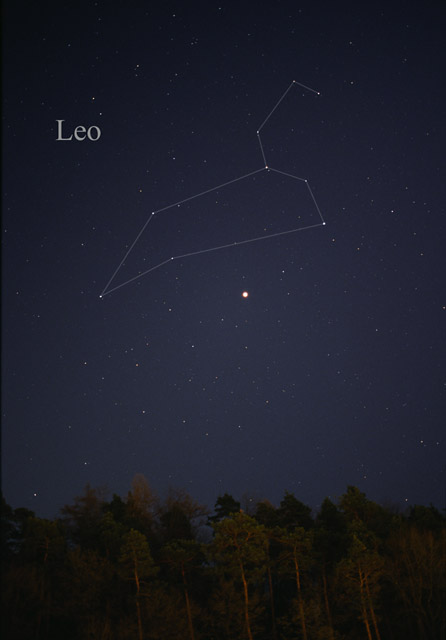
Leo is one of the twelve zodiac constellations, the name "zodiac" sharing its origin with the word "zoo" -- appropriate for the ring of mythical animals found in the sky. Leo is a very easy-to-locate constellation because it has one very bright star (Regulus) and quite a few moderately bright stars in a distinctive pattern that resembles a lion. The image at left shows the general outline of the stars in Leo, with the sickle (or backwards question mark) at the head of the lion, something that is easily identifiable as Leo rises in the east in the winter. For the coming months, it will be appearing higher in the east and traversing nearly overhead throughout the evening.

Because they form a band around the sky that follows the Sun's path, each of the zodiac constellations has frequent visitors as they grace the night sky, from the Moon to the planets. Leo has been the home of Saturn for the last three years, but now Saturn is drifting slowly eastward into Virgo. On the west side of Leo is Mars, currently in retrograde in Gemini, but soon to be speeding toward Leo and a close encounter with the bright star Regulus in June.

Take some time to become acquainted with this celestial Lion, and you'll know how to quickly navigate to Saturn and Mars throughout the spring and into the summer.

01 January 2010

Mars arrives in the evening sky

Mars is back on display, now visible shortly after sunset in the eastern sky. During the month of January it will reach "opposition" when it appears exactly opposite the Sun in the sky. At opposition Mars is also at closest approach to Earth (and is therefore at its brightest for the year). It shines a distinctive red-orange color especially when compared to the stars in Leo and Cancer that surround it. Through binoculars or a telescope Mars appears as a small colorful dot of light. This week the Moon serves as a guide for locating Mars.

16 November 2009

Leonid Meteor Shower 2009

The Leonids are reaching their peak tonight. This annual meteor shower peaks every time the Earth moves through the remnants of the comet Tempel-Tuttle. The meteor shower peaks when the Earth is directly intersecting the remnant streams ("filaments") from previous passes of the comet, and the peak for this year will be during the day of November 17th - unfortunate for those of us in the Western Hemisphere, but good for the night side of Earth at that time (primarily Asia).

Don't despair, however, as both the nights of Nov 16-17 and Nov 17-18 should provide some good meteor viewing even here in San Francisco. The Leonids appear to originate from the constellation Leo which rises in the east after midnight. As with all meteor showers, viewing gets better late at night into the early morning. Dress warmly and try to see a few. I'll be out early tomorrow to see what I can see.

14 September 2009

Brilliant Venus shining in the morning sky

Venus, the brilliant morning "star", dominates the morning sky. During the next week it will have a close encounter with the waning Moon and then a very close alignment with Regulus, the brightest star in the zodiac constellation Leo. Now that the sunrise is getting later each morning, it's not so unusual to get up when it is dark enough to see brilliant Venus in the eastern sky. The diagrams will help you to find your way in the eastern sky.

04 September 2009

Saturn has no rings!

If you could get a good telescopic view of Saturn today, you would find that it has no rings. At least that would appear to be the case for several days as another rare phenomenon takes place in the Solar System. Of all of the beautiful objects in the sky, Saturn is one of those wonderful heavenly targets that can be seen from cities and country, from spacecraft and flying telescopes, and always impresses the viewer. The second largest planet in the Solar System, Saturn has the largest and most distinctive ring system (Jupiter, Uranus and Neptune also have ring systems). The detailed photographs sent back to Earth from the Voyager and Cassini spacecraft and the Hubble Space Telescope have given us stunning perspectives into the depth and intricacies of the Saturnian ring system.

Saturn's ring system is very thin (less than 50 feet thick), and when viewed 'edge-on' from Earth it is virtually invisible. Saturn, like Earth, has a tilt in its rotation such that it has seasons as it moves around the Sun in its 30-year orbit. Consequently, every 15 years we see the ring system from the side and for a short while it disappears from view altogether. Although the ring system is very thin, it is extremely wide -- about 170,000 miles across, making the system even bigger than Jupiter!

Saturn is currently moving its way westward across the constellation Leo the Lion and is not visible due to its proximity to the Sun in the morning sky. It will gradually emerge from the glare of the dawn and be visible before sunrise. By the end of the year it will be rising in the east just before midnight and by next spring will be a gorgeous evening object with its ring system back in view. Until then, enjoy Jupiter and its fascinating moon system -- except when they aren't there!