Four of the five most-visible planets are bunched together in the morning sky, creating beautiful patterns along the eastern horizon at dawn for the next few weeks. Each day the four planets change slightly in position, with bright Venus guiding your eyes to the right spot on the horizon where you can see these four points of light. Use binoculars to find all four planets - Mercury and Mars are much fainter than Jupiter and Venus - and use this amazing animation on the Sky & Telescope website to find the exact pattern as it changes each day. In San Francisco, you will want to look for this between 5:00 and 5:30 am, before the glare of the sunrise washes out the view of the planets.
 06 May 2011
Venus, Jupiter, Mars and Mercury in Conjunction
Four of the five most-visible planets are bunched together in the morning sky, creating beautiful patterns along the eastern horizon at dawn for the next few weeks. Each day the four planets change slightly in position, with bright Venus guiding your eyes to the right spot on the horizon where you can see these four points of light. Use binoculars to find all four planets - Mercury and Mars are much fainter than Jupiter and Venus - and use this amazing animation on the Sky & Telescope website to find the exact pattern as it changes each day. In San Francisco, you will want to look for this between 5:00 and 5:30 am, before the glare of the sunrise washes out the view of the planets. 

KFOG Podcast - May 6, 2011
In today's podcast, KFOG's Irish Greg and I talk about the big planetary conjunction, how to find deep-space objects, upcoming astronomy lectures and star parties on Mt. Tam, and the likelihood of astronomical chaos on May 21st :-) Listen here!
04 May 2011
Eta Aquarid Meteor Shower 2011
 Meteors are wonderful to see, arriving unannounced and fleeting in an instant across the sky, obligating the hopeful viewer to pay attention or miss this spectacle of the heavens. On any given night if you simply are out viewing the skies, you will probably see one or two, but throughout the year there are special times when the Earth's orbit takes us through a region of space dust, creating meteor showers, in which the intensity and regularity of meteors increases dramatically.
The Eta Aquarid meteor shower peaks Thursday night, the night of May 5th into the morning of May 6th. This is not the biggest meteor shower of the year, but it certainly is interesting because it is caused by small bits of debris from the trail of Halley's Comet, the famous comet that orbits the Sun and is visible from Earth every 76 years. Comets leave small trails of debris in their wake, and comets that have orbits that intersect the orbit of Earth around the Sun create our annual meteor showers. So if you see an Eta Aquarid meteor tonight, you'll know it was once part of Halley's Comet, having been stripped away by the heating of the Sun on some past fly-by of Earth.
To see this shower, as is the case for all meteor showers, you need a dark location (even a backyard shielded from streetlights in the city will do), warm blankets, a recliner chair or a patch of grass to lie on, a big view of the sky, and patience. The name of this shower is based on Aquarius (the constellation) where the meteors appear to originate from, but they are visible all over the sky. Best viewing for this shower is early morning. The dawn sky will start to brighten around 5:00 am, so you will need to start early Friday morning if you want to see these. Have fun!
02 May 2011
The Last Vestiges of the Winter Sky
 The young Moon graces the last vestiges of the winter sky this week, creating a beautiful pattern in the west for several evenings in a row. The big, bold constellations of winter including Orion, Taurus and Canis Major, and the very distinctive asterism the Winter Triangle are sinking lower each evening into the glow of the sunset sky, and on May 4th, 5th and 6th the Moon enters the picture to create a spectacular evening picture.
 I have been doing Star Parties and outdoor presentations on astronomy the last few weeks, and the change from week to week has been dramatic. There is a natural change to the sky each evening, as the constellations and bright stars along the celestial equator and zodiac (ecliptic) move approximately 1 degree westward toward the sunset. At the same time, the length of each day is growing, meaning that these great winter constellations are disappearing rapidly into the glare of sunset. But there is nothing to worry about -- they will make their way around the sky to rejoin the view in the early morning, and continue the great ritual of the sky changing slowly from one season to the next.
25 April 2011
Viewing Gemini and a Deep Space Gem, M35
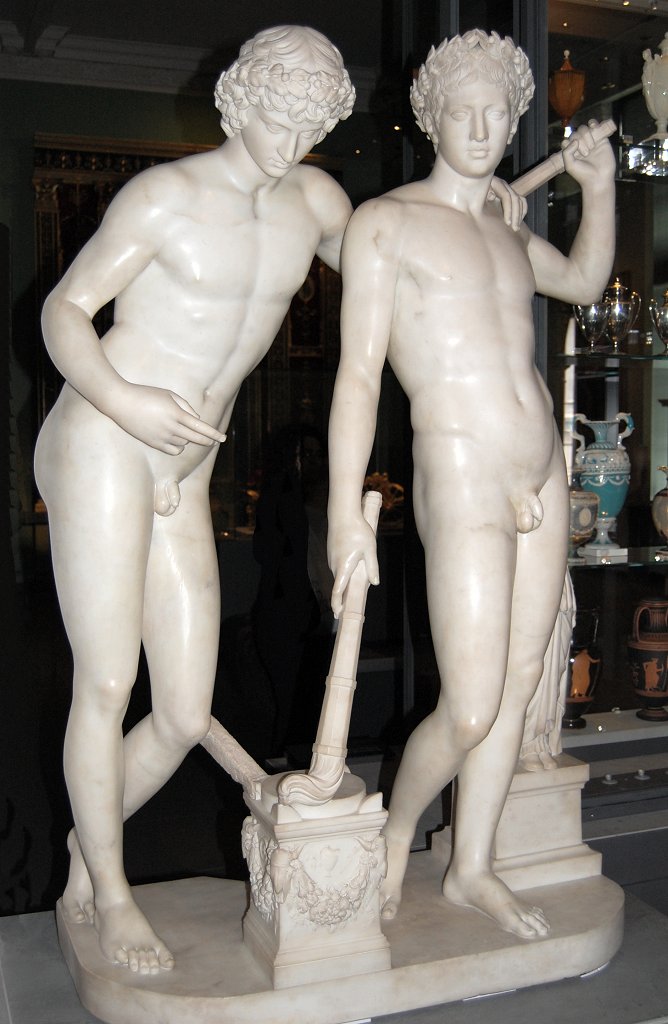
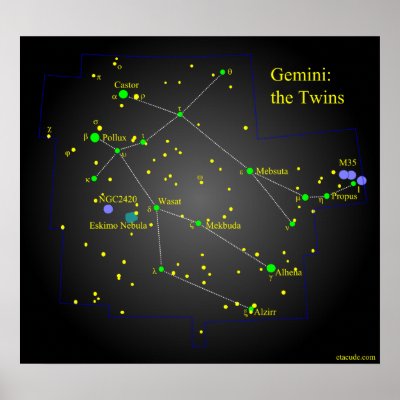
 Spring skies are dominated by an array of bright stars and distinctive constellations. In April and May, the zodiac constellation Gemini dominates the view to the west, gracing the sky with the twin stars Castor and Pollux, and guiding the curious observer toward a gem in the river of the Milky Way, which flows across the legs of the twin brothers.
 The star pattern of Gemini is of the brothers Castor and Pollux standing side by side. The bright twin stars represent the heads of the twins, and the stars that are below Castor and Pollux trace out their bodies, arms, legs and even a foot. An advantage to viewing Gemini in the Spring is that the brothers are standing upright and are easy to see, whereas in other times of the year when Gemini is visible, the brothers are not in an easy-to-spot orientation, or are directly overhead, a difficult thing to see.
If you have binoculars, you can try to spot a very faint but beautiful star cluster called M35 near the foot of Castor, the twin on the right-hand side of the pair. You will need a star chart (click on the image above, or try this fine star chart) to locate this small circle of stars but if you have patience and a dark viewing location, you will know you have found it because M35 seems to glow in the view of your binoculars compared to the stars around it. The stars in M35 are quite distant, nearly 3000 light-years away (but still within the Milky Way galaxy).
Happy viewing, and good luck with M35!
17 April 2011
Five Weeks of Planets in Conjunction
We are entering a period of time in which several planets are going to be in close proximity to each other, creating special alignments called "conjunctions." Mars, Mercury, Jupiter and Venus are all occupying the same region of the sky from our Earth-bound point of view, and as these planets and our own planet are all in motion around the Sun, the pattern we see in the sky changes quite a bit from one night to the next. At this time, all of these planets are emerging from the glare of the brightening dawn sky, appearing in the east just minutes before sunrise. Therefore, the initial conjunction on April 19th is best visible with the aid of binoculars. But this is just the start of a five week period in which these planets move very close to one another, creating a beautiful series of patterns for the early morning observer.
Our planet moves nearly 2 million miles per day in its orbit around the Sun. The planets are also moving at high speed around the Sun in their respective orbits. Mercury and Venus move the fastest relative to Earth, and because of their unique position inside the orbit of Earth, we see their changing locations in the early morning just before sunrise, or in the evening just after sunset. The other planets, including Mars and Jupiter for the next few weeks, move more slowly from our point of view and move more steadily from east to west from one morning to the next. I'll be posting a regular series of updates over the next month as the various conjunctions come and go. The important thing for the observer is to find a good eastern horizon, dust off the binoculars, and be ready to get up just before sunrise to see these cosmic alignments.
04 April 2011
The Moon and two Star Clusters: Pleiades and Hyades
The Moon graces the last vestiges of the winter sky this week, as the waxing Moon splits two of the prettiest star clusters, the Pleiades and the Hyades. This will be an exciting sight for stargazers, one that will look particularly magical through binoculars. So mark your calendar for Thursday April 7th and watch the show unfold all week long.
When the Moon emerges from the New phase and starts its 29 1/2 day journey around the Earth, the first few days are always a treat, because the waxing crescent offers so much to see through a telescope or binoculars, and even without optical aid, the sight of the thinly-lit Moon and the glow of Earthshine always catch your eye.
On Thursday, the Moon moves past the Pleiades star cluster, one of the best known clusters in the sky because the stars in it are fairly bright and concentrated into a small space, creating a kind of glow in the sky. Around the bright star Aldeberan in Taurus is the open cluster called the Hyades. These stars are also a close grouping in the sky, but not as tightly arranged, so you don't get the same kind of glow. However, through binoculars this cluster offers much to see.
Use the graphic (above) to help you orient yourself this week. You will want an observing location with a clear western horizon, away from streetlights or other distractions, and good weather. If you get all these conditions just right, you have no excuse for missing this gem of a celestial lineup. And if you live in San Francisco, come join me at the Cal Academy for a personal tour :-)
KFOG Podcast - April 4, 2011
In today's podcast with Irish Greg of the KFOG Morning Show, we discuss the upcoming alignments of the Moon with star clusters in the evening sky, and I tell Greg about the upcoming festivities on Thursday in San Francisco at the Cal Academy's "NightLife" party celebrating Yuri's Night. It's quick and fun, so click here to listen.
Subscribe to:
Posts (Atom)


 Posts
Posts