We are in an "Eclipse Season," a five week period of time when the Moon's orbit around the Earth is aligned in a way that the Full or New Moon crosses the path of the Earth around the Sun. When that happens, we experience a Lunar or Solar Eclipse and right now we have one of each coming up: a partial Lunar Eclipse on Saturday 26th, and a total Solar Eclipse on July 11th. The Solar Eclipse will not be visible from North America so we don't get a chance to experience that, but the Lunar Eclipse will be. More on that next week.
During an Eclipse Season, the Moon's position in the sky is special, as it is moving just above or just below the plane of the planets (the "Ecliptic") in the interval from New Moon to Full Moon. A few days ago as the Moon emerged from the evening glare waxing each evening, you could see it move just below Venus, then below Regulus and Mars, and now it is below Saturn and Spica, all objects on or near the Ecliptic. As it nears Full Moon and the Lunar Eclipse on the 26th, it is moving closer and closer to the Ecliptic and will intersect the Earth's shadow on the 26th.
I like to imagine that there is a dark spot in the sky where the Earth's shadow projects out into space. Every month as the Moon nears Full, it sweeps close to that spot. But only during an Eclipse Season -- every six or twelve months -- does it slip into the shadow of the Earth and display to all of us the curved shadow of the Earth. That is something to look forward to next weekend.
19 June 2010


11 June 2010
Heavenly Line-Up

Over the past months the evening sky has been graced by a number of bright stars and planetary configurations. As summer approaches and these stars and planets move westward toward the sunset day after day, heavenly line-ups are emerging that are beautiful to see and are dynamic in nature, changing dramatically from one day to the next.
04 June 2010
KFOG Podcast - June 4, 2010
Today I spent a few minutes talking with Irish Greg of the KFOG Morning Show for their podcast series. Greg is one of those people with boundless enthusiasm and an insatiable appetite for discussion about any topic, so when we talk astronomy it's always a good time. Today's conversation ranged from the Summer Solstice to the upcoming lineup of Mars and Venus and some bright stars, to the June 26th Lunar Eclipse and the Search for Extraterrestrial Intelligence (SETI). Click here to listen.
29 May 2010
High in the sky: The Big Dipper
 The Big Dipper is one of the easiest groupings of stars in the sky to identify, and it serves as a guide to some of the more interesting stars in other parts of the sky. Late Spring evenings it is nearly overhead as seen from San Francisco, and its distinctive pattern provides an interesting exercise for understanding the motions of objects in the heavens.
The Big Dipper is not a constellation, by strict definition, because it is only the brightest 7 stars of the larger constellation Ursa Major. A named combination of stars within a constellation such as the Big Dipper is known as an "asterism." Because of its distinctive shape, the Big Dipper is a very well known asterism, one of several celestial groupings that lives up to its name (I put Leo, Scorpius, Cygnus and a few other constellations in this special class).
The Big Dipper points to the North Star (Polaris) if you follow the two stars at the side of the bowl of the dipper. This Wikipedia article illustrates this nicely. The line along the pointers from the Big Dipper to Polaris is helpful because this line is similar to an hour hand on a 24-hour clock. Every 24 hours the Big Dipper makes one counter-clockwise rotation around Polaris. From latitude 38 degrees north (approximately the latitude here in San Francisco) the Big Dipper is high in the sky when it is above Polaris (as it is now at sunset) and low in the sky when it is rotated half way around Polaris just above the horizon (as it will be in late Fall evenings).
The three stars in the handle of the Big Dipper form a curve, and if you think of this curve as an arc, you can follow it to a very bright star called Arcturus (in the constellation Bootes), and by continuing along this arc you end up at another bright star called Spica (in the constellation Virgo).
One more fun thing to find in the Big Dipper is the middle star of the handle, known as Mizar. This star has a very close companion, Alcor, next to it and if you want to test your eyesight, see if you can split the two without using binoculars or a telescope.
Enjoy learning about the Big Dipper in the pleasant weather of May and June. It's full of surprises and one of my favorite stops when sharing the sky with friends and guests at star parties.
08 May 2010
Planets and Bright Stars along the Ecliptic
This is a great time of year to enjoy the view of bright stars and planets demarcating the ecliptic. I am hosting a lot of star parties these days (last week in Tomales, this week in Fremont, next week in Healdsburg and the week after in San Mateo) and I always love to point out the ecliptic, the band across the sky where the planets and Moon are found in their wanderings across the heavens.
 The ecliptic is the plane of the Solar System, the imaginary line across the sky that marks the orbits of the planets and the Moon. In a planetarium this can easily be shown, but under the heavens it is daunting to visualize this. I use a laser pointer to show the path across the sky, and that helps to visualize this, but right now the skies are cooperating to make this a bit easier for those of you without an amateur astronomer and a laser pointer :-)
Face South about 30-45 minutes after sunset and you will be looking toward the ecliptic. It stretches from the point of sunset to your right (West) where bright Venus gives you one reference point, then stretches up and toward the south to Castor and Pollux, the two twin stars of the zodiac constellation Gemini. Just to the upper left of the pair is bright orange Mars, and continuing left you encounter blue-white Regulus, the brightest star in the zodiac constellation Leo. Now the line of the ecliptic moves down toward the East, that is, down and to the left as you face South. Lower left of Leo is the planet Saturn, a bright, milky-white dot of light. And continuing to the lower left of Saturn is the bright star Spica, in the zodiac constellation Virgo.
Enjoy the tour, and if you have a star chart, put it to work so you can use these bright points of light to help you learn a few constellations. Even in the big city, all of these are visible.
The image on this page was copied from Nick Strobel's Astronomy Notes. Go to his site at www.astronomynotes.com for the updated and corrected version.
The ecliptic is the plane of the Solar System, the imaginary line across the sky that marks the orbits of the planets and the Moon. In a planetarium this can easily be shown, but under the heavens it is daunting to visualize this. I use a laser pointer to show the path across the sky, and that helps to visualize this, but right now the skies are cooperating to make this a bit easier for those of you without an amateur astronomer and a laser pointer :-)Face South about 30-45 minutes after sunset and you will be looking toward the ecliptic. It stretches from the point of sunset to your right (West) where bright Venus gives you one reference point, then stretches up and toward the south to Castor and Pollux, the two twin stars of the zodiac constellation Gemini. Just to the upper left of the pair is bright orange Mars, and continuing left you encounter blue-white Regulus, the brightest star in the zodiac constellation Leo. Now the line of the ecliptic moves down toward the East, that is, down and to the left as you face South. Lower left of Leo is the planet Saturn, a bright, milky-white dot of light. And continuing to the lower left of Saturn is the bright star Spica, in the zodiac constellation Virgo.
Enjoy the tour, and if you have a star chart, put it to work so you can use these bright points of light to help you learn a few constellations. Even in the big city, all of these are visible.
The image on this page was copied from Nick Strobel's Astronomy Notes. Go to his site at www.astronomynotes.com for the updated and corrected version.
25 April 2010
A Beacon in the Twilight
As the days grow longer and the last vestiges of twilight linger later in the evening, look to the West this week for some very beautiful planetary/celestial lineups. The week features fast-moving Venus passing very near to some of the most spectacular star clusters in the night sky, the Pleiades and the Hyades.
When you look into the twilight sky, the brightest objects shine majestically against the bright blue background. That is the case for Venus this week, as it is for the young crescent Moon each month when it shines low in the West in the first few days after new Moon. However, in order to see the star clusters near Venus, you will need to use binoculars. The stars are there to see, but the bright twilight makes them all but invisible to the naked eye. It's worth the time to get out and see this spectacle. Sunset in San Francisco is just before 8:00 pm, and the sky will be dark enough about 45 minutes to an hour after that.
14 April 2010
09 April 2010
Mars and the Beehive
Over the past few weeks I have been watching the gradual change in position of Mars as it moves from retrograde to prograde motion across the sky, now moving steadily eastward across the constellation Cancer and next to a beautiful cluster of stars knows as the Beehive Cluster, or M44.

Mars, like all other planets, moves eastward from our point of view most of the time but when Earth have just the right alignment (as we did with Mars over the last few months) a planet may appear to travel westward, and we call this motion "retrograde." Click on the image to see how Mars was in retrograde from December through March.
Now that Mars is moving eastward again, it is traversing a part of the constellation Cancer where you can find the Beehive Cluster, an open cluster of stars (like the nearby Hyades cluster in Taurus). It is relatively close to the Solar System compared to most clusters, and it is a gem in binoculars. With Mars as your guide "star" you can easily navigate to the Beehive Cluster high overhead this time of year. It's worth a few minutes to see if you can spot it.

Mars, like all other planets, moves eastward from our point of view most of the time but when Earth have just the right alignment (as we did with Mars over the last few months) a planet may appear to travel westward, and we call this motion "retrograde." Click on the image to see how Mars was in retrograde from December through March.
Now that Mars is moving eastward again, it is traversing a part of the
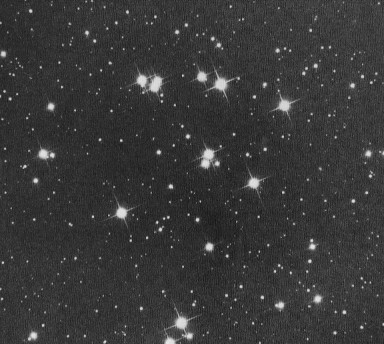 constellation Cancer where you can find the Beehive Cluster, an open cluster of stars (like the nearby Hyades cluster in Taurus). It is relatively close to the Solar System compared to most clusters, and it is a gem in binoculars. With Mars as your guide "star" you can easily navigate to the Beehive Cluster high overhead this time of year. It's worth a few minutes to see if you can spot it.
Subscribe to:
Posts (Atom)


 Posts
Posts


