The Quadrantids peak this evening and continue through Thursday January 4th, lighting up the sky with 'shooting stars' that are enchanting to see, if you have dark clear skies and are able to brave the wintery cold night. The Quadrantids ring in each new year with a good display of meteors, and are favorable for us in the Northern Hemisphere because the 'radiant' (the point from which the meteors appear to emanate) is high in the northern sky. Here are some helpful articles with more details about the shower.
EarthSky.com has a thorough article.
Space.com has helpful sky maps.
To enjoy the Quadrantids, follow the usual rules for a meteor shower: (a) dress warmly and have blankets or a sleeping bag, (b) avoid direct lights such as house lights, yard lights and street lights, (c) give yourself time to adapt to the darkness so your eyes can pick up faint meteors as well as big bright ones, and (d) give yourself a view directly overhead with as few obstructions as possible. If you get lucky, you can see up to 40 meteors per hour.
02 January 2013


24 December 2012
Christmas Conjunction
 |
| Christmas Conjunction |
I wish you clear skies and nice viewing as we close 2012.
21 December 2012
KFOG Broadcast - Dec 21, 2012

19 December 2012
Debunking the 2012 Hoax
We are in full swing this week with discussions and rumors about apocalypse on Friday December 21st, 2012. There are numerous claims, including impact by a rogue planet (Niburu), flipping of the Earth's axes, alignment of the planets, alignment of the Earth and Sun and the Galactic Center, and of course most famously, the end of the Long Count Mayan Calendar. All of these are either false or have no connection to science, of course, and scientists are therefore not worried about any of these, since there is absolutely no scientific evidence that any of these things will happen (or in the case of the end of the Mayan Calendar, that there is any reality-based significance of that numerological moment). All we will have on December 21st is the usual winter solstice, a geometric alignment that signifies the endpoint of an annual journey around the Sun, same as any other year.
I like to envision myself in a spaceship watching the Earth in its orbit around the Sun, viewing our home planet whisking across the heavens, spinning on its axis and enjoying its perfect location in the Solar System. From up there, you see the planet in its majesty, much as the Apollo astronauts did, a jewel floating through the blackness of space. And then I envision little people way down there on the planet, asking themselves if a rogue planet is in our midst, but is somehow unseen by anyone. And people worrying about a calendar that was invented years ago, the significance of which is completely irrelevant on the cosmic scale of the Solar System and Universe. And I don't understand how rational, thinking beings on Earth can become so self-obsessed and worried about all of these myths. But over the millennia there have always been doomsday rumors, and apparently it's in our nature to believe such stories. It's myth, and if you stand back and take in the big picture like the astronauts did, you cannot help but see just how irrelevant all of the speculation and rumors are.
If you want to read, on a point-by-point basis, just how science refutes each claim of the 2012 doomsday, visit the highly informative 2012 Hoax website. I have met the creator and contributors to this site, as well as David Morrison of NASA who has been speaking out against the rumors for several years. Read the real story and don't worry. I'll see you on December 22nd.
Image courtesy of 2012hoax.org.
 |
| Debunking the 2012 Hoax |
If you want to read, on a point-by-point basis, just how science refutes each claim of the 2012 doomsday, visit the highly informative 2012 Hoax website. I have met the creator and contributors to this site, as well as David Morrison of NASA who has been speaking out against the rumors for several years. Read the real story and don't worry. I'll see you on December 22nd.
Image courtesy of 2012hoax.org.
13 December 2012
KFOG Broadcast - Dec 13, 2012
Today I was a guest on KFOG In The Morning, with DJs Tim Jeffreys and Greg Gory. We had a spirited discussion about the Moon and Sun and how they conspire to create King Tides, and discussed the Geminid meteor shower. Click here to listen to the broadcast.
12 December 2012
Geminid Meteor Shower 2012
One of the best meteor showers of the year, the Geminids, peaks the night of Thursday December 13th and continues through the early morning hours of Friday December 14th, as seen from the western hemisphere. This annual shower is generally a good show, and this year will be fully uninterrupted by moonlight, as the Moon is new and will leave the skies dark.
Annual meteor showers are created as Earth passes in the wake of another celestial body, normally an asteroid or comet with a fine trail of dust and debris that burn up in Earth's atmosphere. In the case of the Geminids, they are caused by the remnants of an asteriod. This year, a new comet has left an additional amount of dust and debris and might cause the meteor viewing to be extra-intense.
To see the Geminids, find a dark location away from bright lights or direct lights, dress very warmly, and give yourself 5-10 minutes to adapt to the darkness. Look up and you'll see the meteors, as they will streak across any part of the sky. The common aspect of these meteors is if you trace the path of the meteor backwards, they will appear to emerge from the constellation Gemini (see image). But don't worry, you don't need to point any one direction or use a telescope. Meteor showers should be relaxing events, with plenty of time to gaze into the heavens and enjoy the glorious night sky.
Image courtesy of Sky & Telescope.
 |
| Geminid Meteors |
To see the Geminids, find a dark location away from bright lights or direct lights, dress very warmly, and give yourself 5-10 minutes to adapt to the darkness. Look up and you'll see the meteors, as they will streak across any part of the sky. The common aspect of these meteors is if you trace the path of the meteor backwards, they will appear to emerge from the constellation Gemini (see image). But don't worry, you don't need to point any one direction or use a telescope. Meteor showers should be relaxing events, with plenty of time to gaze into the heavens and enjoy the glorious night sky.
Image courtesy of Sky & Telescope.
09 December 2012
Asteroid Sighting
 |
| Ceres and Vesta |
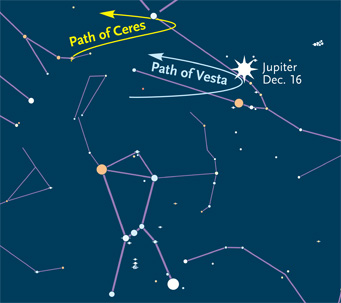
Right now, two of the biggest asteroids are fairly easy to spot, being located high in the night sky and nearby a variety of easy-to-locate landmarks. There are good articles with additional details on the web, including Sky & Telescope and MSNBC Space. The MSNBC article has some very simple diagrams showing the exact location of the asteroids Ceres and Vesta, as they wander through the constellation Taurus. Using binoculars, they should stand out as fairly bright points of light and be distinct against the backdrop of stars in Taurus. I am not an 'asteroid hunter' and don't have lots of experience finding these, but I have used binoculars and telescopes to find the faint outer planets Uranus and Neptune, and anticipate that Ceres and Vesta will be similar. I'll report findings here on the blog comments.
The NASA spacecraft Dawn is on a mission to visit both asteroids, having already orbited Vesta and now is en route to Ceres. (Note: although Ceres was historically classified as an asteroid, it has recently been reclassified to a Dwarf Planet, just like Pluto!)
Image courtesy of Sky & Telescope.
02 December 2012
Jupiter at Opposition: Closest approach of the Year
 |
| Jupiter at Opposition |
It's easy to spot the four brightest Moons (also known as the Galilean Moons) of Jupiter if you use a simple telescope or binoculars. With Jupiter at opposition, now is the time to take a closer look. If you want to actually identify which Jovian moon is which, use this handy app from Sky & Telescope.
Image courtesy Space.com.
Subscribe to:
Posts (Atom)


 Posts
Posts


