13 December 2012
KFOG Broadcast - Dec 13, 2012
Today I was a guest on KFOG In The Morning, with DJs Tim Jeffreys and Greg Gory. We had a spirited discussion about the Moon and Sun and how they conspire to create King Tides, and discussed the Geminid meteor shower. Click here to listen to the broadcast.


12 December 2012
Geminid Meteor Shower 2012
One of the best meteor showers of the year, the Geminids, peaks the night of Thursday December 13th and continues through the early morning hours of Friday December 14th, as seen from the western hemisphere. This annual shower is generally a good show, and this year will be fully uninterrupted by moonlight, as the Moon is new and will leave the skies dark.
Annual meteor showers are created as Earth passes in the wake of another celestial body, normally an asteroid or comet with a fine trail of dust and debris that burn up in Earth's atmosphere. In the case of the Geminids, they are caused by the remnants of an asteriod. This year, a new comet has left an additional amount of dust and debris and might cause the meteor viewing to be extra-intense.
To see the Geminids, find a dark location away from bright lights or direct lights, dress very warmly, and give yourself 5-10 minutes to adapt to the darkness. Look up and you'll see the meteors, as they will streak across any part of the sky. The common aspect of these meteors is if you trace the path of the meteor backwards, they will appear to emerge from the constellation Gemini (see image). But don't worry, you don't need to point any one direction or use a telescope. Meteor showers should be relaxing events, with plenty of time to gaze into the heavens and enjoy the glorious night sky.
Image courtesy of Sky & Telescope.
 |
| Geminid Meteors |
To see the Geminids, find a dark location away from bright lights or direct lights, dress very warmly, and give yourself 5-10 minutes to adapt to the darkness. Look up and you'll see the meteors, as they will streak across any part of the sky. The common aspect of these meteors is if you trace the path of the meteor backwards, they will appear to emerge from the constellation Gemini (see image). But don't worry, you don't need to point any one direction or use a telescope. Meteor showers should be relaxing events, with plenty of time to gaze into the heavens and enjoy the glorious night sky.
Image courtesy of Sky & Telescope.
09 December 2012
Asteroid Sighting
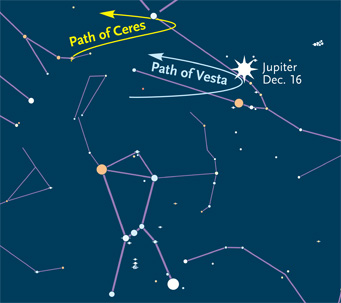 |
| Ceres and Vesta |
Right now, two of the biggest asteroids are fairly easy to spot, being located high in the night sky and nearby a variety of easy-to-locate landmarks. There are good articles with additional details on the web, including Sky & Telescope and MSNBC Space. The MSNBC article has some very simple diagrams showing the exact location of the asteroids Ceres and Vesta, as they wander through the constellation Taurus. Using binoculars, they should stand out as fairly bright points of light and be distinct against the backdrop of stars in Taurus. I am not an 'asteroid hunter' and don't have lots of experience finding these, but I have used binoculars and telescopes to find the faint outer planets Uranus and Neptune, and anticipate that Ceres and Vesta will be similar. I'll report findings here on the blog comments.
The NASA spacecraft Dawn is on a mission to visit both asteroids, having already orbited Vesta and now is en route to Ceres. (Note: although Ceres was historically classified as an asteroid, it has recently been reclassified to a Dwarf Planet, just like Pluto!)
Image courtesy of Sky & Telescope.
02 December 2012
Jupiter at Opposition: Closest approach of the Year
 |
| Jupiter at Opposition |
It's easy to spot the four brightest Moons (also known as the Galilean Moons) of Jupiter if you use a simple telescope or binoculars. With Jupiter at opposition, now is the time to take a closer look. If you want to actually identify which Jovian moon is which, use this handy app from Sky & Telescope.
Image courtesy Space.com.
25 November 2012
Full Moon, Partial Eclipse, and Jupiter
 |
| Full Moon |
The morning of Wednesday November 28th, the Moon touches the edge of Earth's shadow in space, creating a faint darkening of the northern limb of the Moon, also known as a Partial Eclipse. For San Francisco and the western US, the Moon's darkening will be most visible just before sunrise, during the 6:00 am hour.
Image courtesy of Sky & Telescope.
14 November 2012
Leonid Meteor Shower 2012
 |
| Leonids |
To see the Leonids, find a dark location and let your eyes adapt for at least 10-15 minutes. Dress warmly and relax on a blanket or lawn chair, looking overhead or somewhat toward the east. The 'raidant' of the meteor shower is in the constellation Leo which rises high in the east after midnight, and the meteors will appear to emanate from that spot, but will shoot all over the entire sky, so most important is to have a view of as much of the sky as possible. City dwellers should find the darkest possible spot. In my own backyard, I place myself in a dark area where the local streetlights are shielded from view, allowing my eyes to adapt and see fainter meteors.
Stay warm, and enjoy the show. Here are some additional resources:
Space.com article about the Leonids.
Earthsky.org article about the Leonids.
Image courtesy howstuffworks.com.
26 October 2012
Jupiter Returns to the Evening Sky
 |
| Jupiter rises into view. |
Image courtesy of Sky & Telescope.
14 October 2012
Red Stars at Night
 |
| Evening Sky this week |
If you have an extra-clear western horizon, you can try to locate the faint Mercury and the very young Moon shortly after sunset on Tuesday 16th. This will require the use of binoculars to spot them, but if conditions permit, it will be quite impressive to see.
Image courtesy of Sky & Telescope Magazine.
Subscribe to:
Posts (Atom)


 Posts
Posts


