08 December 2010

Geminid Meteor Shower 2010

One of the best Meteor Showers of the year takes place in favorable conditions on Monday night December 13th into the morning hours of December 14th. The shower is called the Geminids, named after the constellation Gemini. The Geminids appear to originate from the constellation Gemini which rises shortly after sunset and is high in the sky around midnight. This point in the sky is called the radiant, and if you trace the paths of the meteors backwards, they will all converge in this point.

Meteor showers generally get better late into the night because the Earth is rotated in the direction of its orbit around the Sun and consequently we encounter a higher number of meteors, on average. This is certainly true for the Geminids, and in dark conditions after midnight you might see 1 or even 2 meteors a minute. Being winter, you have to really prepare for this by dressing extremely well for your local conditions. I plan to get up early and look for Geminids in the early morning hours of Tuesday 14th, since the Sun does not impact the viewing until after 6:00 am.

This year is particularly favorable for the Geminids because the Moon is at First Quarter and will not be a factor after midnight. Stay warm and enjoy the show!

Image courtesy of Earth Sky.

03 December 2010

KFOG Podcast - December 3, 2010

Today on the KFOG Morning Show Podcast with Irish Greg, we talked about the discovery of new stars in the galaxy, alien life forms right here on Earth, the upcoming Geminids Meteor Shower on December 13-14, the upcoming Total Lunar Eclipse on December 20-21, and Holiday Shopping including a special 10% discount on anything at Scope City in San Francisco (my favorite place to shop) if you mention KFOG or The Urban Astronomer. Click here to listen. And take advantage of the 10% offer while it lasts!

28 November 2010

Brilliant Venus and Old Moon in the Dawn Sky

With sunrise at 7:00 in the morning, I find this time of year to be one in which I can do some early morning stargazing without having to change my morning routine. This week the waning Moon provides a lovely scene against the backdrop of brilliant Venus, bright Saturn and the bright star Spica. The illustration demonstrates what to expect in the eastern skies as the Moon shrinks each day on its way to the New Moon on December 5th. If you are a morning person with an interest in astronomy, this will be an excellent week for you. Get out your binoculars for an especially riveting view of these heavenly bodies, and take in a few minutes of beauty about an hour before the sunrise.

22 November 2010

Review of iPhone Astronomy Apps: ISS Visibility and Iridium Flares

Two of my favorite iPhone apps are ISS Visibility and Iridium Flares, apps that help you to locate satellites very precisely. I use these two apps extensively, anytime I have clear skies and want to enjoy the spectacle of dazzling satellites crossing the sky, even here in the bright city lights of San Francisco. Continuing from my previous post on iPhone apps, here are two more reviews.

ISS Visibility does exactly what it promises by telling you when and where to look to see the International Space Station. Transits of the ISS across the evening or morning sky are impressive, whether the viewing is of the space station crossing a broad arc across the sky, or a short appearance that ends in the impressive flickering and fade of the ISS as it crosses the Earth's shadowline from daylight to night. At a price of $1.99, ISS Visibility gives you simple-to-use charts based on your location, and shows you where to look along with a nice 2D map showing the location of the ISS over Earth as it passes your viewing site.

Iridium Flares are bright lights in the sky that shine when Iridium Satellites in orbit around Earth reflect sunlight back toward the planet and produce a particularly bright glint of light in the sky for a few seconds. I find iridium flares wonderful to watch because at their best they flare up to -7 or -8 magnitude, many times brighter than Venus or Jupiter at their brightest. Also, being able to predict these special events is quite a lot of fun. I love to show off iridium flares to friends when the conditions permit. The Iridium Flares iPhone App costs a mere $0.99 but will pay back many times over.

Enjoy these two apps to see things in the sky that will certainly impress you.

15 November 2010

Leonid Meteor Shower 2010

A very fine meteor shower arrives this week. The Leonids peak on the night of November 17 and morning of November 18th, bringing a fairly reliable collection of meteors to the eastern skies. Best viewing is well after midnight into the early morning hours (around 4:00 AM until sunrise), when the Moon will have set and the Earth is better positioned to intersect more meteors.

Star Date Online has a nice article and image about the Leonids, so named because they appear to originate in the zodiac constellation of Leo. The constellation rises in the early morning sky and dominates the eastern sky. As the Sun does not break the darkness of the morning sky until 5:30 AM, the best darkness will be from 4:00 until 5:30 at which an observer in dark skies can see dozens of meteors per hour. Another good online resources is Astronomy.com with a good article on the Leonid shower.

Image from Astronomy.com.

26 October 2010

KFOG Podcast - October 26, 2010

Today's Urban Astronomer talk with Irish Greg of the KFOG Morning Show features the North Star, Meteor Showers in November and December, some early shopping tips for the holidays, cool iPhone Apps, Jupiter and more. It's always a treat to talk with KFOG and share some astronomy tips with the listeners. Click here to listen.

24 October 2010

Waning Moon, Morning Darkness

Each month the Moon makes a 29 1/2 day journey around the Earth, bringing different faces of the Moon to light, making beautiful patterns with the surrounding stars and planets, and shining light into the evening, midnight or morning skies. Right now, the Moon is waning, getting smaller each night as it passes through gibbous phases while moving from Full Moon to Last Quarter, lining up with bright celestial objects such as the Pleiades and Taurus. During the gibbous phases, the orientation of the Moon is quite different from what we normally expect in the evening skies.

The illustration shows the changing orientation of the Moon just after sunset in the waxing phases, as the Moon grows from New to Full. This view is for Northern Hemisphere viewers. But after the Full Moon, the orientation reverses and is best measured in the sunrise sky. So the view you can see right now is of a Moon curved not toward the east as normally seen in the evening sky, but rather curved toward the west in the morning sky. It's refreshing to see this time of year while it is so dark in the morning, and it provides a chance to see things in a different light. Eye-opening.

Image courtesy of University of Virginia.

12 October 2010

An Elusive Comet in Urban Skies: Hunting for Hartley 2

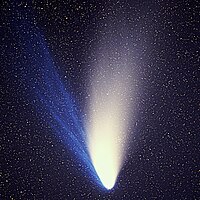
Comets can be bold and brash, streaking across the sky like Hale-Bopp in 1997 (see image on right), a comet that was visible even in light-polluted urban areas. Comets can be more humble but then unexpectedly brighten, as did Comet Holmes in 2007. This year marks the return of periodic Comet Hartley 2, a small but frequent visitor to the inner Solar System that is making a fairly close pass to the Earth (11 million miles) on October 20th. Because of the bright Moon on October 20th, this and last week mark the best chances to see the comet because the Moon is young and not brightening the sky. So I took a look last week and again this week to see if I could spot this elusive comet from a city location (last week in a suburb of Frankfurt, Germany and this week from my home in San Francisco).

I hunted quite a while on both occasions, using this very helpful map from Sky and Telescope Magazine. In fact, S&T has been running updates as viewers report seeing Comet Hartley 2 with binoculars. However, it seems that to see Comet Hartley 2 you need a location with very dark skies. I can attest to this, having twice tried and failed to discern the comet from the surrounding stars.

However, all is not lost. Searching for Hartley 2 requires you to find Cassiopeia, Perseus and Auriga, three very nice constellations that grace the Fall and Winter skies. While searching the path of the comet, you encounter a range of deep space objects near and between Cassiopeia and Perseus, and tonight the view was quite good. So even though city lights may have drowned out the faint comet, I enjoyed my first good look at the Double Cluster in Perseus and other celestial gems in the spiral arm of the Milky Way that is beyond Cassiopeia.

I recommend a good jacket, a comfortable chair or blanket, a few minutes patience, the S&T sky map, and binoculars. No matter whether your hunt for Comet Hartley 2 is a success or not, you will be glad you made the effort.