22 September 2010

Autumnal Equinox and the rate of change of the length of the day

Today is the Autumnal Equinox, one of two Equinoxes of the year. These are days that mark the transition from one season to the next, but also are days that have very special significance as the Earth orbits the Sun. Because of the tilt of the Earth's rotational axis, the Northern and Southern Hemispheres receive radically different amounts of sunlight from June through December, as the seasons progress from Summer to Fall to Winter (northern hemisphere). This is well understood and we learn from basic science courses that the in-between points while transitioning from Summer to Winter, for example, are the days that have equal periods of the Sun above the horizon and below the horizon -- equal duration of night and day -- hence Equinox. Today, everywhere on the planet, the Sun spent exactly 12 hours above the horizon and 12 below, and the Sun rose due East and set due West. From now through March, the Sun will be above the horizon more than 12 hours a day in the Southern Hemisphere, and less than 12 hours a day in the Northern Hemisphere.

I love the symmetry and simplicity of the Sun's motion on this day. It marks a transition as the days are getting shorter in the Northern Hemisphere. Everyone can feel the shortening of the days and sense, innately, that the changes in daylight and darkness are sudden and surprising. This is another fascinating change happening at the Equinox, more subtle but no less fascinating to me. When people sense the changes to the onset of darkness in the evening or the late sunrise in the morning, they are noticing that the length of the day is changing quite quickly and they feel that the times of day that might have been bright and sunny only a few weeks ago are now getting dark. At the time of the Equinox, the length of the day is changing most rapidly. For example, here in the San Francisco Bay Area, the longest day in summer is nearly 15 hours long and in winter the shortest day is approximately 9 1/2 hours. As the seasons change, the time of sunset and sunrise changes slowly, starting at the solstice in June - maybe only 1/2 to 1 minute per day. But then the changing becomes more rapid approaching the Equinox. At the time of the Equinox this week, the length of a day is changing 3 minutes per day -- that is, about 20 minutes in one week! So if you feel like the length of the days is changing very fast, you are absolutely correct.

The change is even more dramatic the farther north or south you are. For example, in Alaska, the length of the day is changing right now about 5-6 minutes per day, or about 40 minutes in one week! Imagine how that would feel, and it is a natural thing that happens every Spring and Fall. I think it is amazing how much the seasons impact the different geographies of the world, and a little understanding of the natural foundation for these effects is a nice thing to have.

20 September 2010

Jupiter's closest approach to Earth

Today Jupiter is at its closest point to Earth for 2010, a mere 368 million miles. Although not a particularly astonishing event, it is nonetheless a prime time to get out your binoculars or telescope to view the giant planet as it dominates the night sky. Jupiter is a fun target to view up close because it offers so much to see: Four bright Moons, colors and textures from its cloud belts, and for a brief time right now it guides you to find the distant planet Uranus.

Every year as the Earth moves around the Sun, at some point in time it is at its closest approach to Jupiter. This moment is called "opposition" and is when the Earth, Sun and Jupiter are all in a perfect line. Each year the distance between the Earth and Jupiter might be a bit more or less depending upon the circumstances of each planet's orbit. This year, the distance is smaller than usual (closest since 1963 and until 2022), but that difference is relatively small from year to year. More important is that the planet is at its brightest for the year, and remains high in the sky for optimum viewing for the entire night.

Sky and Telescope Magazine has an excellent article about this close encounter if you want more details.

14 September 2010

Blue Star, Red Star, Yellow Star

When conducting a star party, I always point out star colors. Most of the time, people see the stars as uniformly white, but in fact upon closer inspection it's easy to see that stars have color, sometimes very dramatic color. This time of year there are several colorful bright stars that illustrate nicely the range of what you can see in the sky.

The southern sky is dominated by the distinctive shape of Scorpius, the Scorpion of the Zodiac constellations. The "heart" of this constellation is the bright red supergiant star Antares. It is in the middle of the body of the scorpion and it is one of the biggest stars we can see, so big that if places in the Solar System it would enclose Mercury, Venus, Earth and Mars. To the observer, it looks a reddish-orange color.

High above this time of year is the Summer Triangle, featuring three of the brightest stars in the sky. One of these three is Deneb in the constellation Cygnus, the "Northern Cross." Deneb appears blue to the observer and in fact is indeed a blue-white supergiant star, similar to Antares in terms of massive size, brightness and distance from the Sun.

These two beautiful stars should be enough to whet your appetite for detail when you look at the night sky. They are bright enough and easy to spot and display color quite nicely. But don't stop there. A simple pair of binoculars gets you enough resolution to see an amazing array of color in so many of the stars in the sky.

The colors of the stars is an indication of their temperature. Like the different levels of heat in flame, the colors of stars follows a similar pattern with red being cooler and blue being hotter. There are yellow stars, hotter than the red giants, and next in line are white stars, cooler than the blue stars. Details of Stellar Classification and Color Index are documented on very fine websites for those who want to learn more about star colors.

10 September 2010

KFOG Podcast - September 10, 2010

Another fun visit with Irish Greg of the KFOG Morning Show, today featuring a discussion of constellations to see this time of year (Sagittarius, Scorpius, The Summer Triangle) and the difference between an asterism and a constellation, plus deep-space objects you can see in the Milky Way with an ordinary pair of binoculars. And the latest happenings with the Moon and Venus, and an update on a great star party and lecture this weekend. All in 7 short minutes! Click here to listen.

08 September 2010

Get Involved: Astronomy Lectures, Star Parties and more

The Bay Area has many great astronomy resources and if you want to expand your knowledge of the universe and have a good time, check out one of these upcoming astronomy-oriented events.

Star Party and Lecture on Mount Tamalpais: The San Francisco Amateur Astronomers (SFAA) hosts monthly lectures and star parties at the Mountain Theater on Mount Tam in Marin County from April through October. Ken Frank is giving a talk this weekend (Saturday 11th September at 8:30 pm) on the Globe At Night project, highlighting the effects of light pollution
worldwide. Details on the Mount Tam website. Following the lecture, the SFAA has telescopes set up for public viewing.

Benjamin Dean Lecture Series at Cal Academy: The California Academy of Sciences in Golden Gate Park in San Francisco hosts excellent programs on many areas of science. The Dean Lectures focus on astronomy and this month (Monday 13th September at 7:30 pm) the talk is on the Search for Extraterrestrial Intelligence (SETI) with Jon Jenkins of the SETI Institute. Tickets and information at the Cal Academy website.

The San Francisco Amateur Astronomers monthly meeting is always open to the public. This month's meeting features NASA Ames astronomer Chris McKay speaking about extreme environments on heavenly bodies in the Solar System. The meeting is on Wednesday 15th September at 7:30 pm at the Randall Museum in San Francisco. More details on the SFAA Website.

I hope to see you at one of these excellent events.

23 August 2010

Perspective of the Solar System

After weeks of foggy skies in San Francisco, the sky has started clearing, yielding spectacular sunsets and sky shows at Ocean Beach. I have been writing about (but not seeing much of) the amazing sight of the planets dancing across the evening sky. With the clear skies, the view was great, showcasing Venus and Mars very close together, with Saturn just to the lower right and the bright Zodiac start Spica (in Virgo) just to the upper left.

This configuration traces a curve in the sky and if you have a clear southern horizon you can "connect the dots" from this cluster of stars and planets to the south where bright Jupiter dominates the sky. Beyond that, the Moon is slicing across the lower southern sky, providing the observer with a nice visual of the Ecliptic, the line of the planets, Moon and Sun. This is a great way to visualize the path of the planets in the Solar System when you look out from our Earth-bound perspective.

Over the coming months, Mars and Saturn and eventually Venus fade, but the giant planet Jupiter will be dominating the Fall skies.

11 August 2010

Perseid Meteor Shower 2010

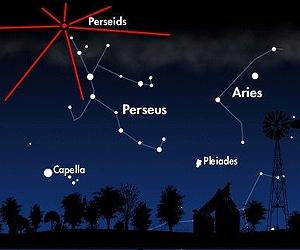
The Perseid Meteor Shower reaches its peak this week and the timing is very good for a fine display of meteors. Every year when the Perseids come around, the biggest concern is the Moon. Its beautiful light is a welcome sight to many, but for amateur astronomers and anyone wishing to see more than a few meteors, moonlight can ruin an otherwise-perfect evening of viewing. This year the Moon is very young during the Perseids and sets not long after sunset, leaving a dark sky for the shower.

The Perseids peak on the nights of Thursday 12th and Friday 13th, with best viewing on Thursday night / Friday morning. You can get detailed information on the Sky and Telescope website or on numerous other web resources.

The best way to see the meteor shower is to find a dark location, give your eyes plenty of time to adapt to the darkness, and be prepared to stay up late (or get up early). Meteor showers are almost always best viewed after midnight when the Earth is powering directly into the meteor stream and the rate increases substantially. The Perseids appear to originate in the constellation Perseus which is in the east after midnight, but that does not mean you have to specifically look east to see the meteors. Lying on a blanket facing directly overhead gives you the most expansive view and you can see meteors coming from the east or passing overhead toward the west. Meteors are wonderful, fast, elusive wonders and you simply need to be warmly dressed, in a place where you can see as much of the sky as possible without light distractions, and patience. I wish you clear skies and a great night or two observing.

02 August 2010

Trio of Planets

The evening sky brings us a trio of planets in a close grouping this week. The bright beacon of light, Venus, shines brightly and moves quickly from night to night, especially by comparison to the slower-moving Mars and Saturn. The image shows the view on Sunday August 8th, so looking at this earlier in the week you will find Venus lower and to the right of the other two planets, and after the 8th you will see Venus glide to the upper left of the two planets. We are witnessing the motion of Venus along its orbit around the Sun, moving much more quickly from our vantage point on Earth than Mars and Saturn. Venus will continue to dominate the evening sky for many weeks to come.