While observing in the mountains two weeks ago I saw several meteors streak across the sky. Meteors are always a joy to watch because they appear completely without warning yet are so brilliant to see. Seeing one is the reward for keeping focused on the sky and keeping your eyes open and attentive. Every night of the year there are many meteors to be seen but throughout the year there are particularly intense periods of meteor activity called Meteor Showers. The biggest show of the year is the Perseids Meteor Shower which peaks this year during the morning of August 12th. StarDate Online has a helpful list of meteor showers throughout the year and provides some insight how they happen.
There are two simple guidelines for observing the Perseids. First of all you want to be in a dark location with a clear view of the eastern sky. From San Francisco there is a great deal of light pollution which will obscure many of the meteors. The brightest meteors will still be visible but the rate will be considerably lower than the 1-meteor-per-minute rate you would see in very dark skies. So if you want a good view, drive east away from urban centers. Second of all, you want to view them in the early morning hours when the earth is speeding into the spacedust that makes up the meteor shower and when the moon has set. The best viewing should be from 2 AM until 4:30 AM. NASA has a helpful page showing where to look in the sky. During the early morning hours the rate will increase up to a maximum of 1 per minute.
04 August 2008


02 August 2008
Great eclipse images
 The total solar eclipse of August 1st was well documented. Sky and Telescope has a nice gallery of pictures. I find that photos can't really do justice to the real thing, but a collection of photos like those on Sky and Telescope are interesting if taken in total -- that is, look at many of them and imagine seeing all of these images at the same time with your eye. That is what it is like at an eclipse. Your eye can see a lot more shades of brightness than a camera and besides the visual spectacle of an eclipse, being there is an unforgettable experience.
A colleague showed me this amazing view of the total solar eclipse from an airplane. The most intriguing thing to me is the way the shadow of the moon looks from the vantage point of an airplane and how it moves from north to south during the very short period of totality. It must be a very eerie sight to see in person.
Astrophotographer Dennis diCicco takes excellent photographs and this depicts him at work in China.This image gives you a sense of what it looks like to be there with a dusk-like but not dark sky. You can see Mercury and Venus to the upper left of the sun-moon pair.
The Exploratorium had its usual great coverage of the eclipse live from China. The video is now available for replay on their website. It is a great resource if you want to get an idea of what it is like to be at an eclipse.
29 July 2008
Total Solar Eclipse in China
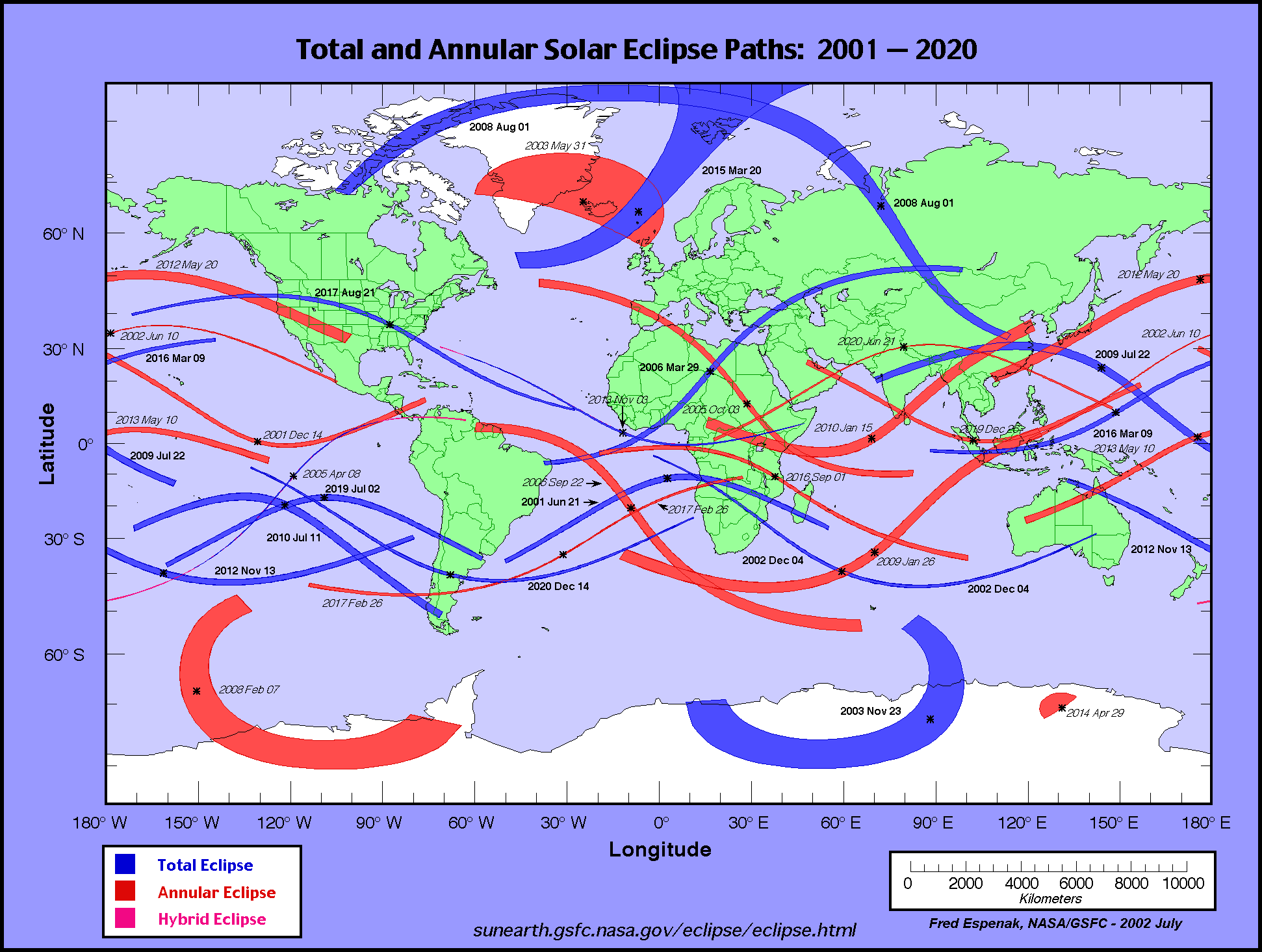
Friday August 1st is the date of the next Total Solar Eclipse. Like lunar eclipses, solar eclipses happen frequently but total solar eclipses are somewhat less common and furthermore, to see a total solar eclipse you generally have to travel to a narrow track (unlike Lunar Eclipses which are visible from just about anywhere on the night side of the earth).
The eclipse this week follows a very narrow track across the arctic regions of the globe and finishes across Siberia and western China. The Exploratorium of San Francisco is sending a crew to report on the eclipse including a live video linkup and webcast from the ground in China. For the hard core eclipse fans who want to feel some of the excitement without leaving the Bay Area, the Exploratorium is having an all night party. The Exploratorium did this for the last total solar eclipse in Turkey (both broadcasting live from Turkey and having a party at the Exploratorium). I had the good fortune to travel to Turkey and witness that solar eclipse from Side on the Mediterranean coast.
Given that the eclipse happens during the afternoon in China, it will be very early Friday morning here in California (4 am). For those who want to watch it live on the internet, you will have to get up early. And for those who are into long-range planning, the next Total Solar Eclipse is in July 2009 in Asia and the Pacific, and in 2017 in the United States.
The eclipse this week follows a very narrow track across the arctic regions of the globe and finishes across Siberia and western China. The Exploratorium of San Francisco is sending a crew to report on the eclipse including a live video linkup and webcast from the ground in China. For the hard core eclipse fans who want to feel some of the excitement without leaving the Bay Area, the Exploratorium is having an all night party. The Exploratorium did this for the last total solar eclipse in Turkey (both broadcasting live from Turkey and having a party at the Exploratorium). I had the good fortune to travel to Turkey and witness that solar eclipse from Side on the Mediterranean coast.
Given that the eclipse happens during the afternoon in China, it will be very early Friday morning here in California (4 am). For those who want to watch it live on the internet, you will have to get up early. And for those who are into long-range planning, the next Total Solar Eclipse is in July 2009 in Asia and the Pacific, and in 2017 in the United States.
27 July 2008
Changing Perspectives
 I spent last week at the Stanford Sierra Camp at Fallen Leaf Lake near Lake Tahoe. At nearly 6400 feet elevation with dry clear skies, the view of the night sky was excellent. I hosted two stargazing sessions during the week in which fellow campers took in the view of deep space objects such as the Lagoon Nebula, Swan Nebula and Andromeda Galaxy plus some riveting views of Jupiter's most prominent cloud belts and the four Galilean Moons. All of this was possible using a 5 inch telescope under the right conditions. The view from the boat dock at Sierra Camp faces east, motivating me to get better acquainted with a few constellations I had never fully appreciated such as Andromeda, Pegasus, Delphinus, Aquarius and even Aquila, because many of the stars in these constellations are not visible in the city. The dark skies gave me a chance to see them in their entirety. It's never too late to see something new so if you get out in the dark this summer, take a star chart and make a few discoveries.
Growing up in Los Angeles I saw summer concerts at the Hollywood Bowl and noticed that even in the bright lights of LA, you can see the Summer Triangle shining above the stage at the Hollywood Bowl. That perspective never has escaped me and whenever I see the Summer Triangle during July or August in the early evening, I can visualize myself looking at the stage at a Hollywood Bowl concert. Last night I was watching Steely Dan at the Berkeley Greek Theater and learned a new view, that of the stars over the Berkeley Greek at night. Above the stage to the left was Scorpio, rising higher as the concert went on. To the right were the stars of Leo (with Mars and Saturn still nearby in the glowing sky after sunset). Just above the stage is Spica (the brightest star in Virgo) and Arcturus (the brightest star in Bootes). Most of the other stars in Virgo and in nearby Libra are too washed out by city light and moisture in the air to be seen above the Greek theater stage, but there were still plenty of bright stars and planets to enjoy. Later in the evening Jupiter, now visible in Sagittarius, rose in the east (above the stage to the left) and dominated the sky. I enjoyed getting to know a new night sky above a popular venue and look forward to the memories of that concert every time I see this particular lineup of stars.
05 July 2008
Planets fading into the sunset
The evening sky has been graced by the sight of Saturn and Mars over the previous months and as the two slowly fade into the glare of sunset they are making one last beautiful show with the Moon and with each other. On July 5th and 6th Mars and Saturn create a beautiful group next to the crescent Moon and they slowly move closer to each other until Thursday July 10th when they are separated by a mere 0.7 degrees, slightly more than width of a full Moon. Mars, being much closer to Earth than Saturn, appears to move a small amount to the east each evening and has been gradually drawing closer to Saturn. It's quite a finale to see these two worlds so close to each other from our point of view. By month's end they will be nearly out of sight.
18 June 2008
Planetary Roundup
Three major planets are well placed for viewing. This chart of Jupiter and the Moon and Sagittarius shows the changing view of the trio as the Moon moves across the sky the evenings of June 18 and 19. Jupiter and Sagittarius will remain in close proximity over the summer with Jupiter being the brightest beacon in the sky each night. Over the summer Jupiter will gradually become visible earlier and earlier in the evening. Saturn and Mars are slowly slipping into the evening glare but remain visible for a short while after sunset. Within the next month they will entirely fade from view, so catch a glimpse and enjoy the show of these two wanderers in the midst of Leo the Lion.
04 June 2008
The Southern Sky
As I write this entry, I am in Melbourne, Australia on a business trip. Melbourne is approximately 38 degrees south of the equator and I have always likened this to San Francisco which is approximately 38 degrees north of the equator. I think of these two coastal cities having similar climate and similar sky conditions but in exactly the opposite way. Being 38 degrees north of the equator San Francisco is heading toward the summer solstice. The days are getting longer and the sky, as always, appears to pivot around the north star which is (by no coincidence) 38 degrees above the northern horizon, with the Sun and planets moving in a long arc across the southern half of the sky.
Melbourne presents a mirror image of the sky in many ways. The Sun does in fact still rise in the east and set in the west, but the Sun and planets move in a long arc across the *northern* part of the sky. The days here are short and getting shorter and Australia and other southern hemisphere countries prepare for the onset of winter in a few weeks. The mirror image of the sky in the northern hemisphere is visible in that the sky appears to pivot around the southern point of the sky. There is no bright star near the southern point of the sky so we don't have exactly the same scenario (ie. no south polar star like Polaris in the northern hemisphere), but the motions are similar -- in the opposite direction.
For example, in the northern hemisphere the Big Dipper moves around the north star in a large sweeping circle in a counter-clockwise direction, but in the southern hemisphere the southern constellations pivot around the south "pole" in a large *clockwise* circle every 24 hours. The Big Dipper and other star patterns and constellations near the north star are visible all night in the northern hemisphere and are called circumpolar stars, but are not at all visible from my location here in the southern hemisphere. Similarly, the circumpolar stars in the southern sky are not visible at all from San Francisco. Hence we never see the Southern Cross or Alpha Centauri (one of the nearest stars to Earth) or the Magellanic Clouds (nearby galaxies) from the northern hemisphere.
The early travelers setting sail across the seas and around the globe noted these changes in the sky and learned some valuable rules about celestial navigation. Although we don't depend upon these markers to tell us where we are on the globe anymore, I enjoy looking out for these changes in motion in the sky as I travel from time to time far north of San Francisco or in this case far south. The Southern Cross is a beautiful sight from here, even though the sky has been too overcast to see much else.
Melbourne presents a mirror image of the sky in many ways. The Sun does in fact still rise in the east and set in the west, but the Sun and planets move in a long arc across the *northern* part of the sky. The days here are short and getting shorter and Australia and other southern hemisphere countries prepare for the onset of winter in a few weeks. The mirror image of the sky in the northern hemisphere is visible in that the sky appears to pivot around the southern point of the sky. There is no bright star near the southern point of the sky so we don't have exactly the same scenario (ie. no south polar star like Polaris in the northern hemisphere), but the motions are similar -- in the opposite direction.
For example, in the northern hemisphere the Big Dipper moves around the north star in a large sweeping circle in a counter-clockwise direction, but in the southern hemisphere the southern constellations pivot around the south "pole" in a large *clockwise* circle every 24 hours. The Big Dipper and other star patterns and constellations near the north star are visible all night in the northern hemisphere and are called circumpolar stars, but are not at all visible from my location here in the southern hemisphere. Similarly, the circumpolar stars in the southern sky are not visible at all from San Francisco. Hence we never see the Southern Cross or Alpha Centauri (one of the nearest stars to Earth) or the Magellanic Clouds (nearby galaxies) from the northern hemisphere.
The early travelers setting sail across the seas and around the globe noted these changes in the sky and learned some valuable rules about celestial navigation. Although we don't depend upon these markers to tell us where we are on the globe anymore, I enjoy looking out for these changes in motion in the sky as I travel from time to time far north of San Francisco or in this case far south. The Southern Cross is a beautiful sight from here, even though the sky has been too overcast to see much else.
20 May 2008
Subscribe to:
Posts (Atom)


 Posts
Posts